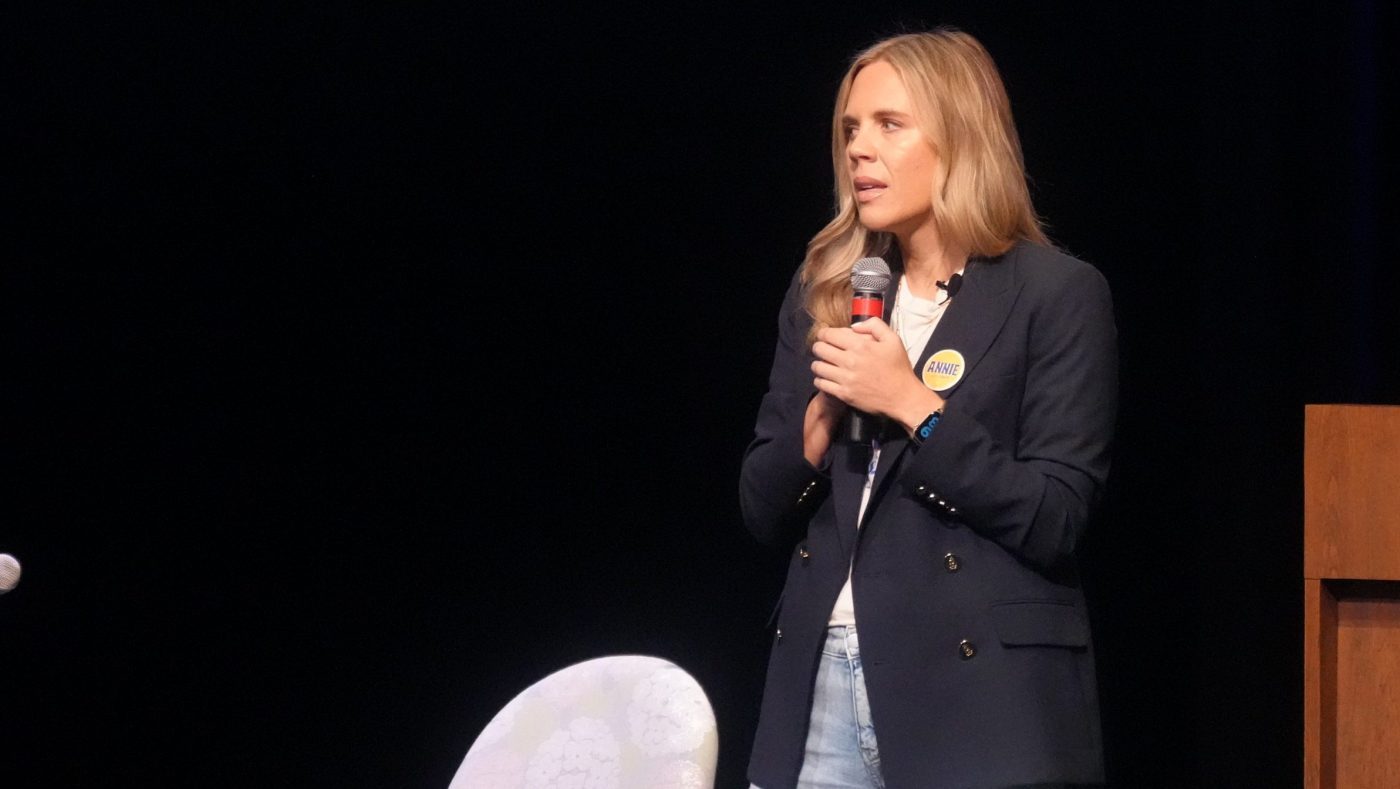
In a move that underscores her moderate positioning in a deeply red state, South Carolina Democratic Senate nominee Annie Andrews on Wednesday dismissed Medicare for All as a relic of the past. Speaking on NewsNation's "On Balance," the pediatrician and first-time candidate said the single-payer proposal is "a policy from a few decades ago," as she seeks to break a 25-year losing streak for Democrats in statewide races.
Andrews, who is running against Republican nominee Darline Graham, emphasized her pragmatic approach as a physician. "When you work as a physician, you have to be a problem solver," she told host Leland Vittert. "You roll up your sleeves, you solve the problem in front of you, you work with whoever you need to work with, you don't let perfect be the enemy of good."

The nomination of Graham, a former state legislator who defeated Rep. Ralph Norman in Tuesday's GOP runoff, has set the stage for a general election that political forecasters see as heavily favoring the Republican. Decision Desk HQ gives Graham an 81% chance of victory, a reflection of the state's conservative lean. No Democrat has won a statewide contest in South Carolina since 1998, when Fritz Hollings and Jim Hodges prevailed.
Andrews has staked her campaign on moderation, particularly on healthcare. "I believe with every cell in my body that healthcare is a human right," she said, "but I'm also a realist, and I understand where we are politically in this country right now. We have to take pragmatic solutions to fix our healthcare system, shift it from a profit-motivated system to a patient-centered system."
Her remarks put her at odds with the progressive wing of her party, which has championed Medicare for All as a flagship policy. Sen. Bernie Sanders (I-Vt.) made the proposal a centerpiece of his two presidential runs, and the Medicare for All Act he introduced with Rep. Pramila Jayapal (D-Wash.) has 17 Senate co-sponsors and 114 in the House. Yet public support for a single government-run system remains tepid: a Pew Research Center poll from last November found only 35% of respondents favored it, while 31% preferred a mix of public and private options.
Instead of pursuing that sweeping overhaul, Andrews argued that the immediate next step should be adding a public option to the Affordable Care Act and reversing Medicaid cuts made under the Trump administration's One Big Beautiful Bill Act. She also called for restoring the ACA premium subsidies that lapsed at the end of last year and for fully funding the CDC and NIH.
"At some point, we'll be able to have a productive bipartisan conversation about how we actually build a health care system that meets the needs of every American," she noted.
Andrews' stance reflects the broader challenge for Democrats in conservative states, where embracing single-payer can be a liability. Her focus on incremental fixes may appeal to moderate voters, but it also risks alienating the progressive base that often turns out in primaries. With the general election looming, she will need to walk that line carefully, especially as national Democrats watch to see if any candidate can break the GOP's stranglehold on the South.
As the race heats up, the South Carolina Senate runoff has already tested the influence of former President Trump, whose endorsement helped Graham secure the nomination. Andrews will now face an uphill battle against a well-funded Republican in a state that has not elected a Democrat to statewide office in over two decades.