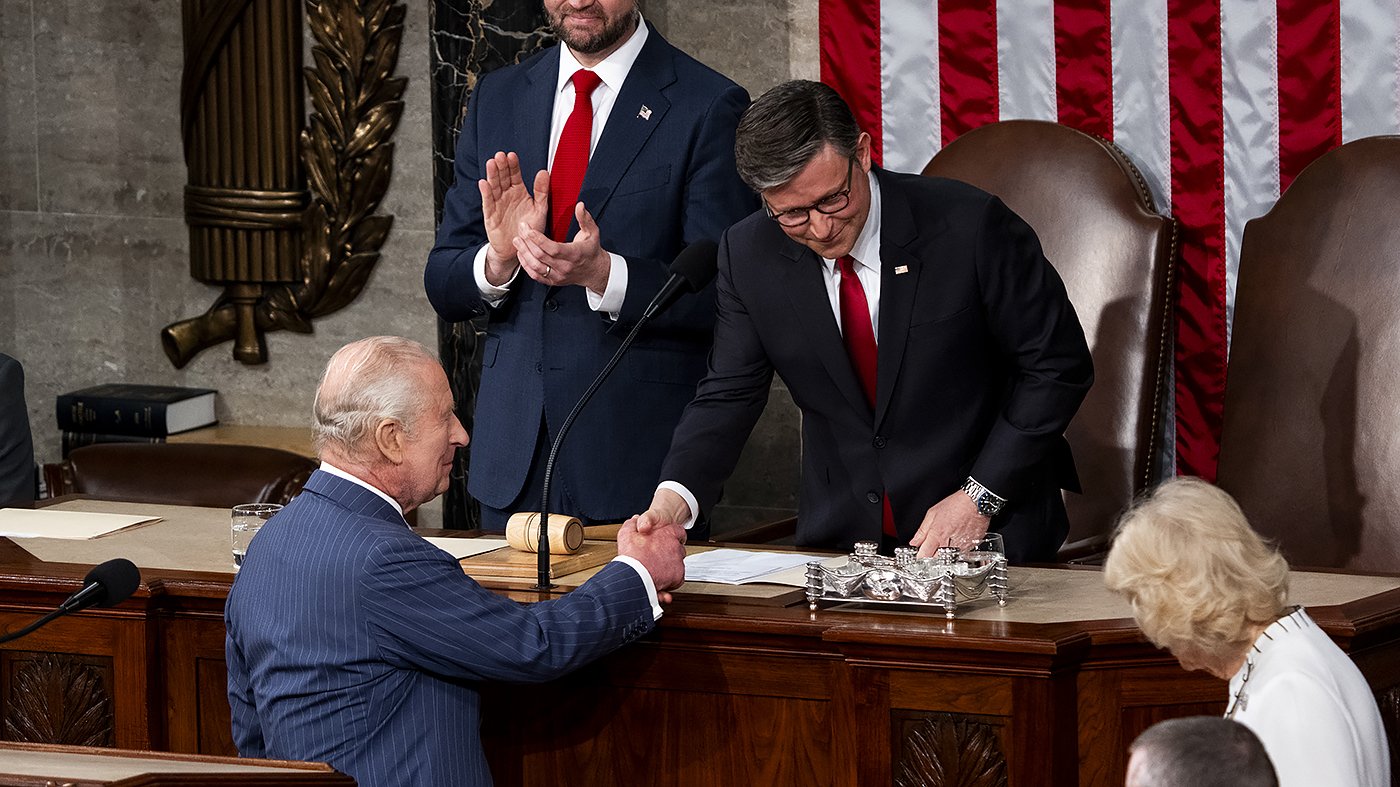
King Charles III of the United Kingdom addressed a joint meeting of Congress on Tuesday, becoming only the second British monarch to do so, following Queen Elizabeth II in 1991. His speech came at a time of heightened tension between the traditionally close allies.
President Trump has repeatedly criticized British Prime Minister Keir Starmer for what he views as insufficient support for the U.S. and Israeli military campaign against Iran. Starmer has countered that Britain has no interest in joining the conflict or pursuing "regime change from the skies."
Charles's visit was framed as an opportunity to ease tensions, but the monarch delivered a more political and pointed speech than many anticipated. Here are the key takeaways.
Charles Hits Trump and Trumpism with Thinly Veiled Jabs
The biggest surprise was the direct, if implicit, criticism of Trump and his approach. While constrained by diplomatic norms, Charles underscored the irony of a king warning against regal, go-it-alone governance. He noted that the Magna Carta established "the principle that executive power is subject to checks and balances," a clear reference to Trump's expansive view of presidential authority.
Near the end of his speech, Charles urged listeners to "ignore the clarion calls to become ever more inward-looking," a swipe at Trump's "America First" unilateralism that has alienated allies like the U.K. He also defended NATO, referenced "disastrously melting ice caps of the Arctic" despite Trump's climate skepticism, and called for international cooperation to "stem the beating of plowshares into swords."
There were conciliatory notes, including an acknowledgment that Britain must bolster its own defense—a frequent Trump demand—and an emphasis on shared values. But the speech was unmistakably antagonistic to the MAGA worldview.
A Vigorous Plea for Ukraine
Charles focused heavily on Ukraine, contrasting sharply with Trump's skepticism. He cited transatlantic unity after 9/11, World War II, and the Cold War, then declared: "Today, Mr. Speaker, that same unyielding resolve is needed for the defense of Ukraine and her most courageous people." The comment drew warm applause, including from Vice President Vance, a prominent critic of U.S. aid to Kyiv.
The GOP, following Trump's lead, has grown increasingly dubious about maintaining support for Ukraine at Biden-era levels. Trump's tense Oval Office meeting with Ukrainian President Volodymyr Zelensky last year highlighted the divide. Charles's clarity underscored the gulf between his stance and Trump's on the war sparked by Russia's 2022 invasion.
No Meeting with Epstein Survivors
The Jeffrey Epstein scandal continued to shadow Charles's visit. Rep. Ro Khanna (D-Calif.) had requested a meeting with survivors of the disgraced financier's abuse, but Charles declined. Khanna wrote on social media, "He should, at least, recognize their courage in his speech today," but no such recognition came.
The issue centers on Charles's younger brother, Andrew Mountbatten-Windsor. Virginia Giuffre, a key Epstein victim, alleged she was forced into sexual encounters with Andrew when she was 17. Giuffre died by suicide last year, but Andrew had settled her civil suit in 2022 for an undisclosed amount, widely reported to be eight figures. He denies wrongdoing. Charles stripped Andrew of royal titles and evicted him from his home, but questions remain about the royal family's knowledge and potential financial involvement.