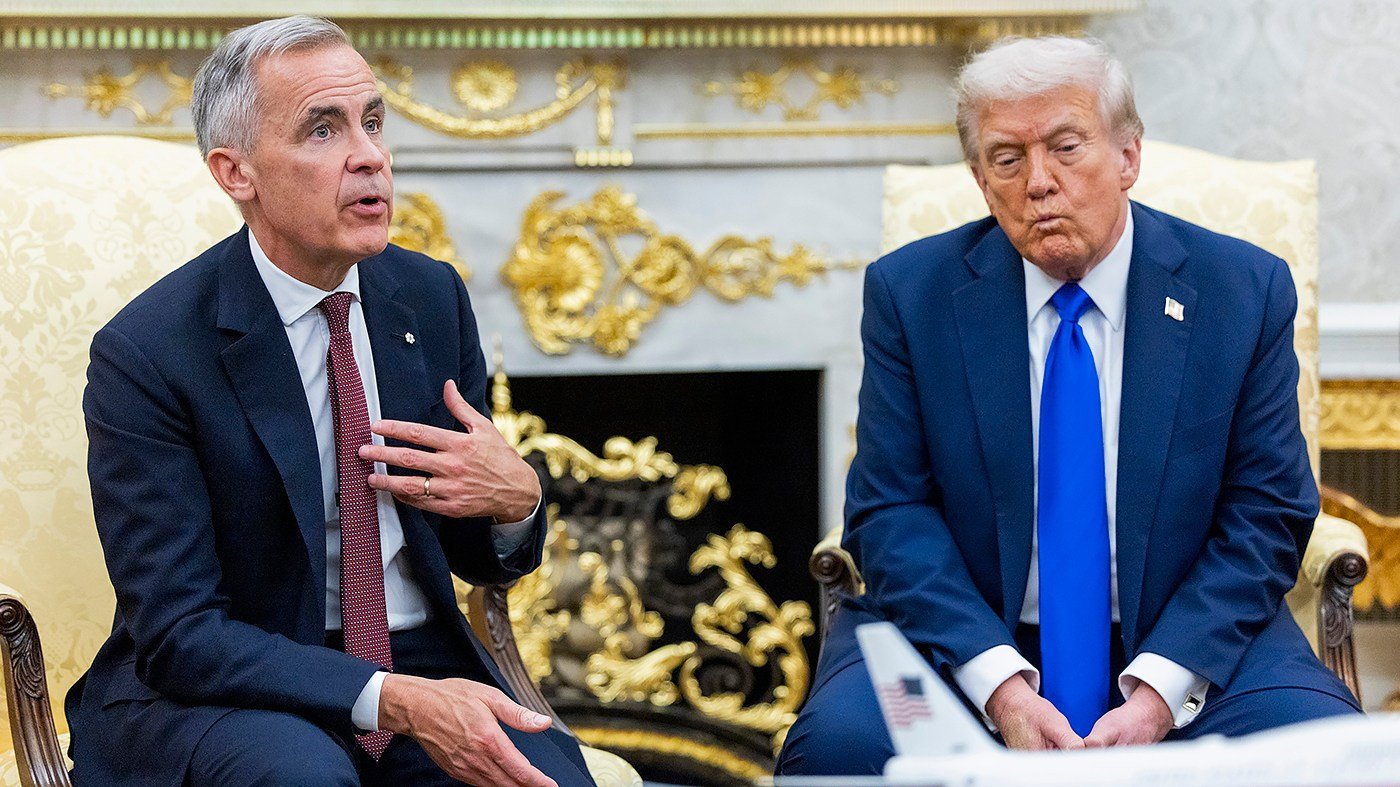
The friction between President Trump and Canadian Prime Minister Mark Carney has turned intensely personal, reflecting the broader trade war that is escalating between the two nations. On Tuesday, Ottawa announced it would impose tariffs on roughly 700 U.S. products, a direct retaliation for recent U.S. levies, with the new duties set to take effect on September 8.
Beyond the economic stakes, the conflict has devolved into a war of words. Trump has repeatedly referred to Carney as "Governor Carney" on social media, a jab that plays into his long-standing suggestion that Canada should become the 51st U.S. state. The president has also accused Carney of being "weak and ineffective" and has even floated renaming Lake Ontario to "Lake America," a taunt that Carney's foreign minister dismissed as a distraction.

The personal animosity appears fueled by Carney's willingness to stand up to Washington. Last week, Carney's team abruptly walked away from trade talks, defying Trump's prediction that a deal was imminent. At a press conference on Saturday, Carney explained that the U.S. had tried to insert last-minute terms that were "uneconomic, unfair," and undermined the reliability of any agreement. He added, "They asked too much, and they offered too little."
Carney's defiance has won praise at home, but it has clearly aggravated Trump. On Tuesday morning, the president posted three messages about Canada before 10 a.m., including one accusing Canada of "ripping off" the U.S. for decades and calling it "the most difficult and unreasonable" country he deals with. He also shared a map with "Lake America" scrawled over Lake Ontario, a move that many saw as trolling.
The clash between the two leaders is not new. In January, Carney gave a speech at the World Economic Forum in Davos that criticized the West's "rupture" and urged "middle powers" to act together, implicitly challenging U.S. reliability. Trump responded by saying Canada "lives because of the United States," to which Carney shot back: "Canada doesn't live because of the United States. Canada thrives because we are Canadian."
Carney, a former governor of both the Bank of Canada and the Bank of England, brings a technocratic, elite background to the confrontation, a stark contrast to Trump's brash style. His calm demeanor and sharp retorts have made him a formidable opponent, and his team's decision to walk away from talks has left the White House scrambling.
As the trade war intensifies, both leaders are digging in. Trump has threatened further tariffs, while Carney has signaled Canada will not back down. The personal animosity between them is now a central feature of the dispute, complicating any potential resolution. With the September 8 tariff deadline approaching, the world is watching to see who blinks first.