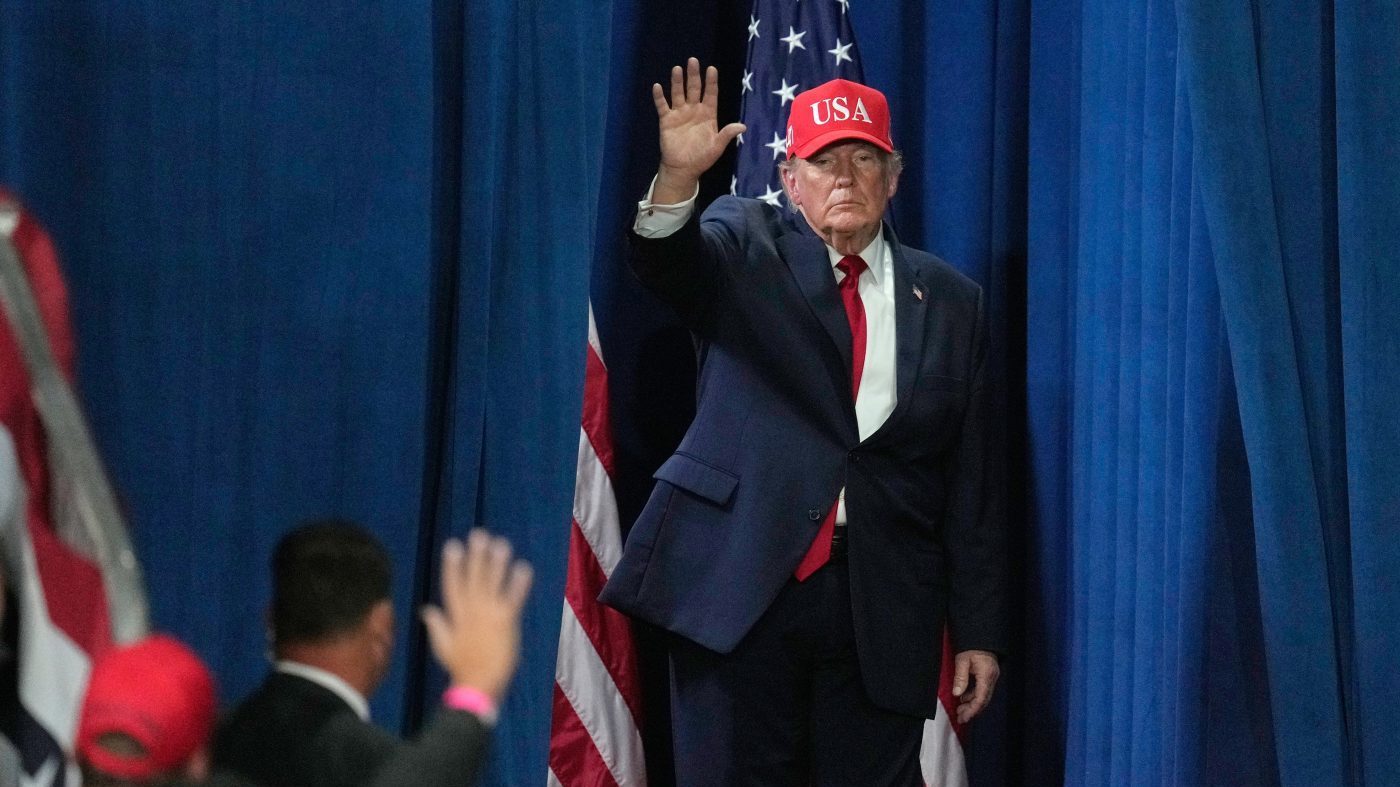
President Trump on Wednesday night used a campaign stop in Montana to cast fresh doubt on the U.S. negotiating posture in the ongoing Iran war, saying he was uncertain who American officials were actually dealing with as diplomatic efforts remain frozen.
Speaking to a crowd in the Treasure State, Trump pointed to the degraded state of Iran's military and leadership, suggesting that the absence of recognizable counterparts had complicated any path to a ceasefire. “They don’t have a navy. They don’t have an air force. Their army is decimated. Their leaders are gone,” he said. “I should have probably left their leaders because I don’t know who the hell we’re negotiating with.”
The president’s remarks come as the conflict approaches its eighth month, a timeline that has increasingly put Republicans on the defensive ahead of the midterm elections. The war has rattled global markets and driven up fuel prices at home, with voters increasingly blaming administration policy for the economic strain.
Trump’s appearance in Montana was part of a broader effort to shore up GOP candidates in competitive races. He was there to back Republican Aaron Flint, who is running to succeed retiring Rep. Ryan Zinke. Flint will face Democrat Sam Forstag in November, and the contest is seen as a bellwether for the party’s ability to hold the House.
Meanwhile, negotiations between Washington and Tehran have hit a wall in recent weeks. Treasury Secretary Scott Bessent acknowledged the uncertainty on Sunday, telling Fox News’s Rachel Campos Duffy, “I don’t know how this ends. You never know how this ends.”
Efforts to restart talks at the United Nations General Assembly late last month collapsed, and Secretary of State Marco Rubio subsequently ordered the Iranian delegation to leave the U.S., accusing them of “overstaying” their welcome. The breakdown has left the administration without a clear diplomatic channel, even as it presses for concrete Iranian commitments.
Vice President Vance has also laid out a firm U.S. position, insisting that Tehran must take verifiable steps to dismantle its nuclear ambitions. “I think if they want to show a commitment to not building a nuclear weapon, they would do something meaningful on their enrichment capacity,” Vance told Reuters. “In other words, the United States is not going to do things for mere promise of actions on the Iranian side. We need to trade actions for actions here, and we’ll see what the Iranians do.”
The president’s latest comments add to a series of mixed signals from the administration, which has at times hinted at openness to talks while also escalating rhetoric against Tehran. With the midterms approaching, the war’s economic fallout and the lack of a clear endgame are likely to remain central issues for voters.
Trump’s rally in Montana also touched on broader themes of national security and leadership, but the Iran question dominated, underscoring how the conflict has become a political liability. As the administration struggles to define a coherent strategy, the president’s own words may complicate efforts to project resolve.