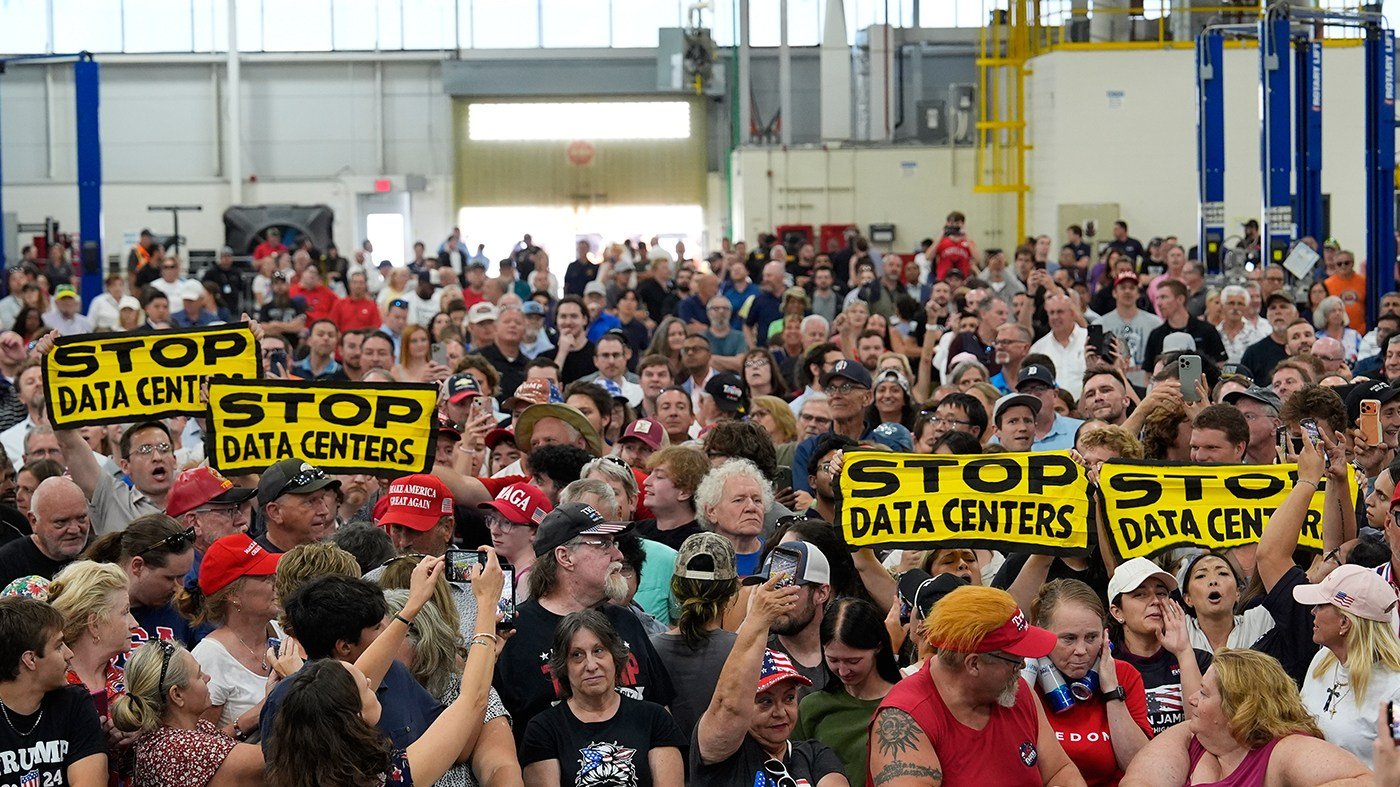
President Trump is navigating a growing intra-party rift over data centers, as Republican candidates and governors face mounting public concern about AI’s impact on communities and the grid. While Trump has repeatedly championed the industry as vital to U.S. technological dominance, he recently signaled he will not force GOP candidates to toe his line on the issue.
“If Republicans are against a data center, that’s okay with me,” Trump told reporters last week, adding that he would support such facilities if he were a local leader because they bring “tremendous income.” His comments mark a notable shift from earlier criticism of Democrats who opposed data center projects.
The president’s remarks come as several high-profile Republicans—including Texas Gov. Greg Abbott and Senate candidates Ken Paxton and Mike Rogers—have moved to embrace stricter oversight of data centers. Abbott, once a vocal supporter of the industry, has ordered state regulators to audit data centers seeking grid connections, arguing that developers have “dug their own grave” by failing to cooperate with local governments.
Trump publicly disagreed with Abbott’s approach, calling it a “mistake,” but he has stopped short of condemning it outright. This balancing act reflects the political reality ahead of the midterms, where data centers have become a flashpoint for voters worried about energy costs, environmental damage, and the risks of AI.
“I’d say [Trump’s] been fairly consistent in his messaging. What’s been more malleable is everybody else’s opinion,” said one Republican strategist. Mark Weaver, an Ohio-based crisis communications adviser, noted that Trump’s language on data centers has been “somewhat muted” compared to other topics, likely due to voter concerns.
Public anxiety about AI has surged, with a Pew Research Center poll showing 52% of Americans are more concerned than excited about AI’s increasing role in daily life, up from 37% in 2021. Data centers, as the most visible physical manifestation of AI, have become a natural target for this backlash.
Democrats have already seized on the issue, proposing moratoriums and tax changes on AI companies. Now, Republicans are following suit. Paxton, running for Senate in Texas, unveiled a four-point plan to “protect our grid, our communities and our children” while still ensuring U.S. leadership in AI. Rogers, in Michigan’s Senate race, has called for a one-year halt on data center construction until residents’ questions are answered.
Despite the pushback, Trump’s administration continues to frame its pro-industry approach as essential to beating China in the AI race. As some propose orbital data centers to sidestep local opposition, the debate is likely to intensify. Trump’s recent comments suggest he is willing to let individual candidates navigate the issue as they see fit, even as he remains a staunch advocate for the industry.
“They’ve seen the polling that all of us have seen, but also I think they’re watching what’s happening in the real world,” said Brendan Steinhauser, a GOP strategist and head of the Alliance for Secure AI, pointing to incidents involving AI-enabled cyberattacks and other risks. “The politics of AI and of data centers specifically have turned for the worse.”
With the midterms approaching, the tension between Trump’s national priorities and local Republican concerns is likely to persist. As Trump’s economic policies diverge from traditional GOP orthodoxy, data centers may become another test of party unity.