President Trump's bid to lift the federal borrowing cap through the end of his term is running into serious opposition from Republican fiscal conservatives, even as rising interest rates on U.S. Treasuries underscore the mounting cost of the national debt, now past $40 trillion.
Trump has been privately pressing Senate Majority Leader John Thune (R-S.D.) and House Speaker Mike Johnson (R-La.) to include a debt ceiling increase in a third budget reconciliation package, aiming to extend borrowing authority into 2029. The move is designed to sidestep a potential standoff with Democrats, who could regain control of the House or both chambers after the 2026 midterms. But that strategy would require near-unanimous GOP support for adding roughly $5 trillion more to the federal debt—a threshold many Republicans say is unlikely to be met.

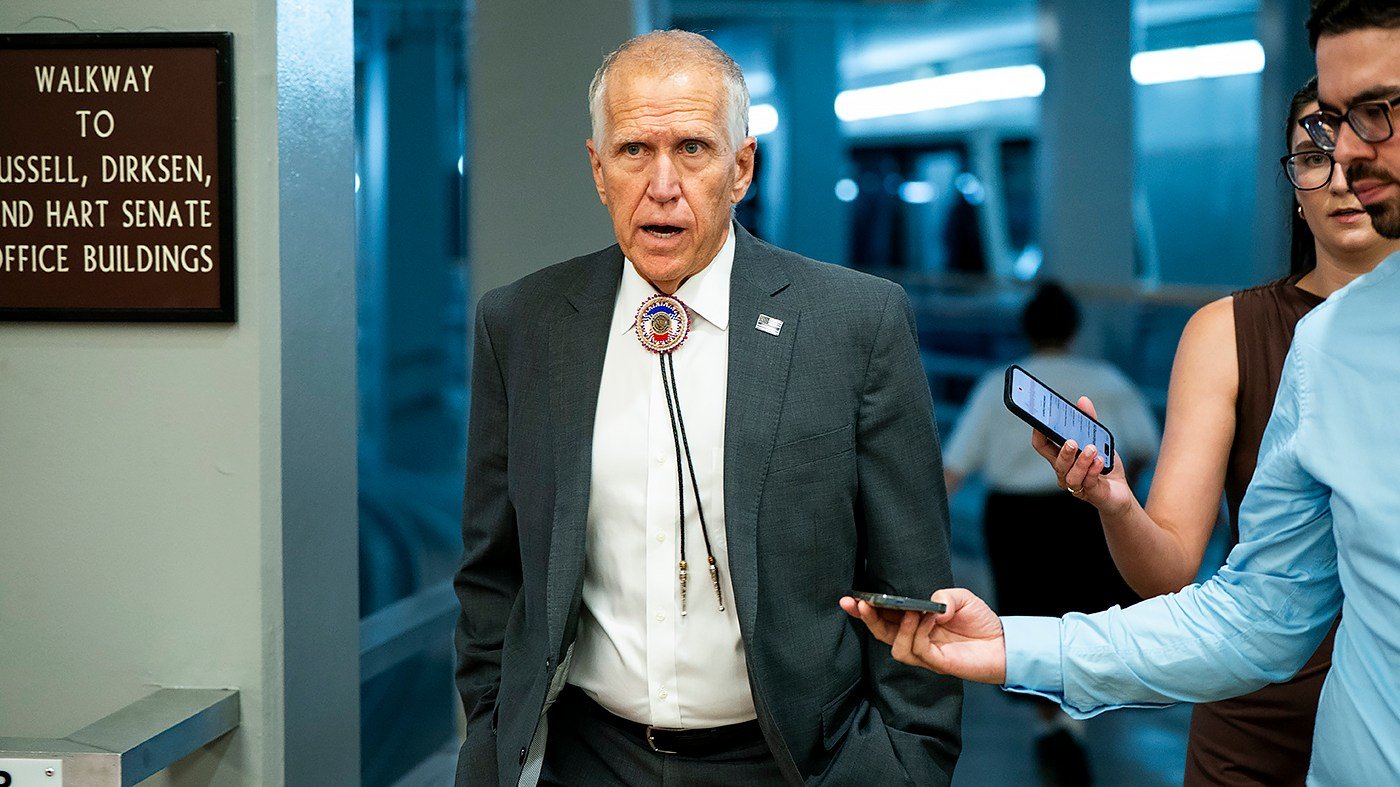
Sen. Thom Tillis (R-N.C.) voiced the skepticism of many, arguing that a two-year debt ceiling hike would remove any pressure to address runaway spending. "If you're really trying to curb the debt, you wouldn't do a debt ceiling for two years. You'd try and use it as a lever to change things," Tillis said. He warned that Social Security and Medicare face insolvency within the decade, with trust funds projected to run dry by 2032 and 2033, respectively. "Every indicator in my mind leads me to believe that before 2032 we'll have to deal with at least one trust fund if not two that will be insolvent," he added, predicting forced cuts that should have been made years ago.
The political friction comes as bond markets signal growing unease. The yield on the 30-year Treasury hit 5.3 percent last week, its highest since 2007, and the average 30-year fixed-rate mortgage climbed to 6.6 percent. Treasury Secretary Scott Bessent attempted to calm markets by announcing a doubling of the government's debt buyback limit, but the 30-year yield still hovered near 5.2 percent this week, with the 10-year at 4.7 percent.
Fiscal hawks like Sens. Rick Scott (R-Fla.) and Ron Johnson (R-Wis.)—who chairs the Senate Budget Committee—argue that inflation is being fueled by persistent deficits and excessive spending. They are demanding that any debt limit increase be paired with significant spending cuts. But assembling a reconciliation package with deep cuts that can pass the narrow GOP majorities in both chambers is a tall order, setting up a year-end clash between Trump and lawmakers over the debt ceiling.
Sen. Rand Paul (R-Ky.) has vowed to oppose any reconciliation bill that raises the debt limit without major reforms. He is championing his "Six Penny Plan," which would cut six cents from every dollar of projected federal spending over five years. "We can't wait any longer. We MUST address our deficit," Paul wrote on social media. Asked about the debt limit, he told The Hill: "I'm for less debt, not more." Paul noted that Republicans already used reconciliation to raise the ceiling by $5 trillion in July 2025 as part of the One Big Beautiful Bill Act, and he questioned the need to do so again so soon. "If we've run out of $5 trillion in borrowing power in a year and a half..." he said, trailing off.
The standoff is reminiscent of past debt ceiling battles, but the stakes are higher as interest costs on the national debt consume a growing share of the federal budget. With the Treasury's buyback program offering only temporary relief, economists warn that the trajectory is unsustainable. Tillis cautioned that another large debt increase would push the total to $45 trillion or even $50 trillion, approaching levels where "most economists say the economy stops to function naturally."
Thune acknowledged that Trump is "keenly interested" in having Republicans raise the debt limit before the midterms, but the path forward remains uncertain. As the lame-duck session approaches, the president's plan hangs in the balance, with fiscal hawks digging in and bond markets watching closely.