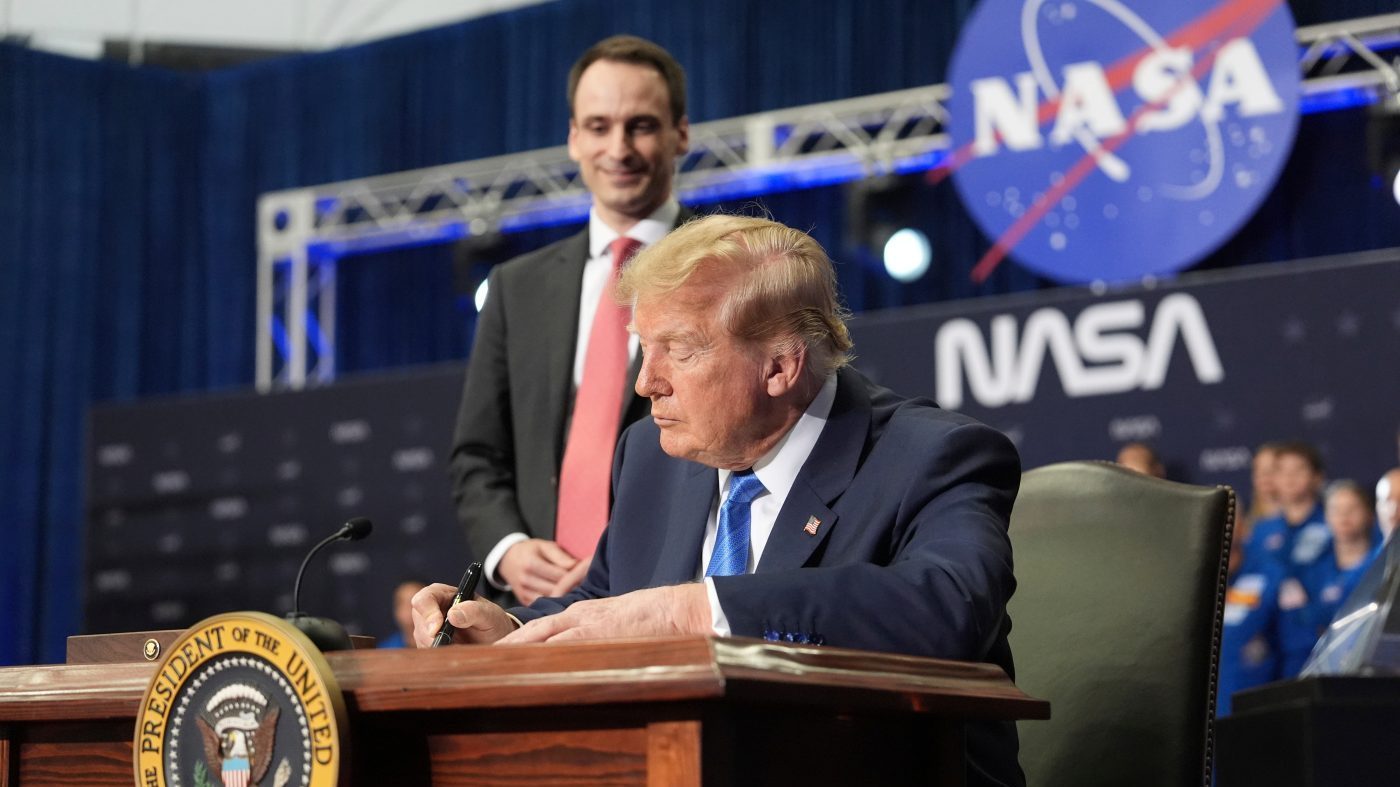
President Trump signed an executive order on Friday establishing the U.S. Space Academy, a new institution designed to educate and train the next generation of space engineers, operators, and military personnel. The announcement came during a visit to NASA's Johnson Space Center in Houston, where Trump also awarded the Congressional Space Medal of Honor to the crew of Artemis II.
Drawing parallels to the nation's premier military academies, Trump said, "That's a big deal. So, you think of West Point, and you think of Annapolis, and you think of the Air Force Academy, and you think of the Coast Guard Academy — great — they're all great, but we're going to have now a space force." He added, "We're going to have an academy for what the people in this room love the most."

The executive order establishes a commission, chaired by NASA administrator Jared Isaacman, to oversee the academy's creation. The commission is tasked with submitting a report to the president within 120 days, proposing key details for the institution's establishment, including its location and curriculum.
The White House stated that the Space Academy will focus on "rigorous technical education with leadership development, discipline and a durable commitment to public service," aiming to produce a "professional corps of civically grounded leaders prepared to advance American interests within the space domain."
Trump said he would select the academy's location "very shortly" and noted that Sen. Ted Cruz (R-Texas) is actively lobbying for the school to be placed in Texas. The selection process is expected to be highly competitive, with other states likely to make bids as well.
This move is the latest in Trump's efforts to prioritize space policy, which included the creation of the U.S. Space Force as a branch of the armed forces in 2019. The Space Academy would serve as a counterpart to the service academies, providing a dedicated pipeline of officers and specialists for the Space Force.
The announcement comes amid broader debates over space funding and priorities. A GOP rift over a NASA bill has threatened Trump's ambitious moon base deadline, highlighting the political challenges in advancing his space agenda. Additionally, the administration has faced scrutiny over other policy areas, including efforts to allow farmers to process their own meat and criticism from New York Governor Kathy Hochul over energy costs.
The executive order is seen as a significant step toward institutionalizing space education, though it will require congressional funding and approval to become fully operational. The commission's report will likely be a key document in shaping the academy's future, with decisions on curriculum, faculty, and location expected to follow.
Trump's emphasis on space has been a consistent theme of his political career, and the Space Academy is poised to become a lasting component of his legacy in defense and technology policy. As the commission begins its work, stakeholders in the space industry and military will be watching closely to see how the academy takes shape.