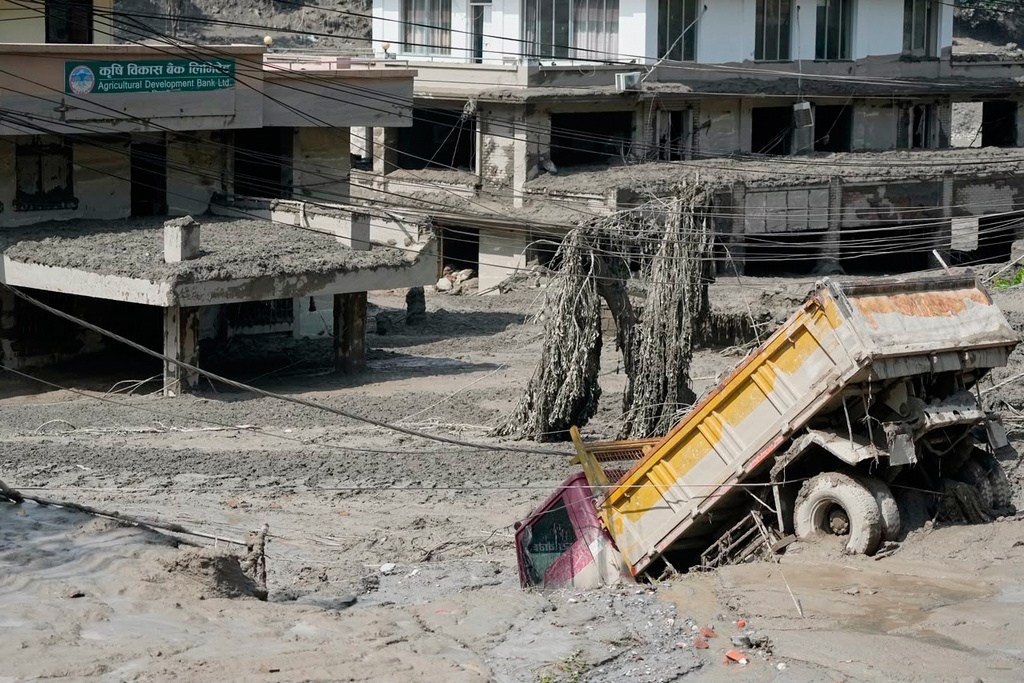
KATHMANDU — A catastrophic flash flood in Nepal on Wednesday has killed at least 22 people and left hundreds of tourists, workers, and residents unaccounted for, as authorities grapple with the scale of destruction across several districts.
The deluge struck around 9 a.m. local time along the Bhotekoshi River, sweeping away villages, roads, and hydropower installations. Officials confirmed that 384 tourists — including 291 from India, the United States, the United Kingdom, and Malaysia — are among the missing.

Nepal's government spokesperson Sasmit Pokharel said rescue efforts are underway, and that both India and China have been asked to assist. “We have asked both India and China to help us with the rescue efforts,” he said.
The district of Nuwakot, north of Kathmandu, is among the hardest hit. Dozens of multi-story buildings, trucks, and vans were buried under thick mud, and officials have warned residents to stay away from the banks of the Bhotekoshi, Trishuli, and Narayani rivers.
Nepal's tourism board indicated that most of the missing foreigners were likely Indian pilgrims and members of the Indian diaspora traveling to Mount Kailash in Tibet, a sacred Hindu site. Meanwhile, South Korean officials said their nationals working on a hydropower project are also unaccounted for. Malaysia's Foreign Ministry reported losing contact with 11 citizens believed to be in the Rasuwa district.
On the Chinese side of the border, authorities in Gyirong have launched large-scale search and rescue operations. Chinese President Xi Jinping ordered stepped-up efforts to locate the missing and evacuate at-risk residents, according to state news agency Xinhua.
Indian Prime Minister Narendra Modi offered humanitarian assistance in a phone call with Nepal's Prime Minister Balendra Shah. “India is prepared to provide Nepal with all possible types of humanitarian assistance,” Modi said on social media.
This region experienced similar flash floods in August last year, when a glacial lake in Tibet overflowed, killing nine and damaging critical infrastructure, including the Nepal-China bridge. Climate experts at the Kathmandu-based International Centre for Integrated Mountain Development believe Wednesday's flood was triggered by an avalanche from a glacier, causing the Lhende Khola River to surge.
“The Lhende Khola has flooded twice in fourteen months, this time triggered by an ice rock avalanche from a glacier on the Nepal side that blocked the river and released a sudden surge downstream,” said Saswata Sanyal, a disaster risk reduction specialist. “In a warming Himalaya, early warning is the first line of adaptation.”
The Himalayan region, spanning Nepal and neighboring countries, is warming faster than the global average due to climate change, making extreme weather events more frequent. Research has shown that glaciers across the Hindu Kush Himalaya are melting at an accelerating rate, with ice loss doubling since 2000.