With President Trump constitutionally barred from seeking a third term, the Republican Party is already grappling with a succession question: Can the MAGA movement survive its founder? And if so, who will inherit its formidable base? Vice President JD Vance has emerged as the most likely heir, but the path forward is fraught with the challenge of transitioning from a personality cult to a sustainable political force.
Vance, in many respects, embodies the MAGA ideology more purely than Trump himself. His foreign policy skepticism, particularly regarding NATO and U.S. commitments to Taiwan, aligns with the movement's nationalist tilt. He has also been a vocal critic of U.S. involvement in Ukraine, a stance that has sometimes put him at odds with the administration's more hawkish elements. This divergence has become more pronounced as Vance has begun to carve out his own positions on Israel and Iran.
Beyond policy, Vance has worked to solidify his standing within the MAGA ecosystem, cultivating relationships with advocacy groups, think tanks, and influencers. His refusal to distance himself from Tucker Carlson, despite the latter's inflammatory remarks, underscores his commitment to the movement's core constituency. Vance's eulogy for Charlie Kirk in 2025 further cemented his role as the intellectual and spiritual heir to Christian populism.
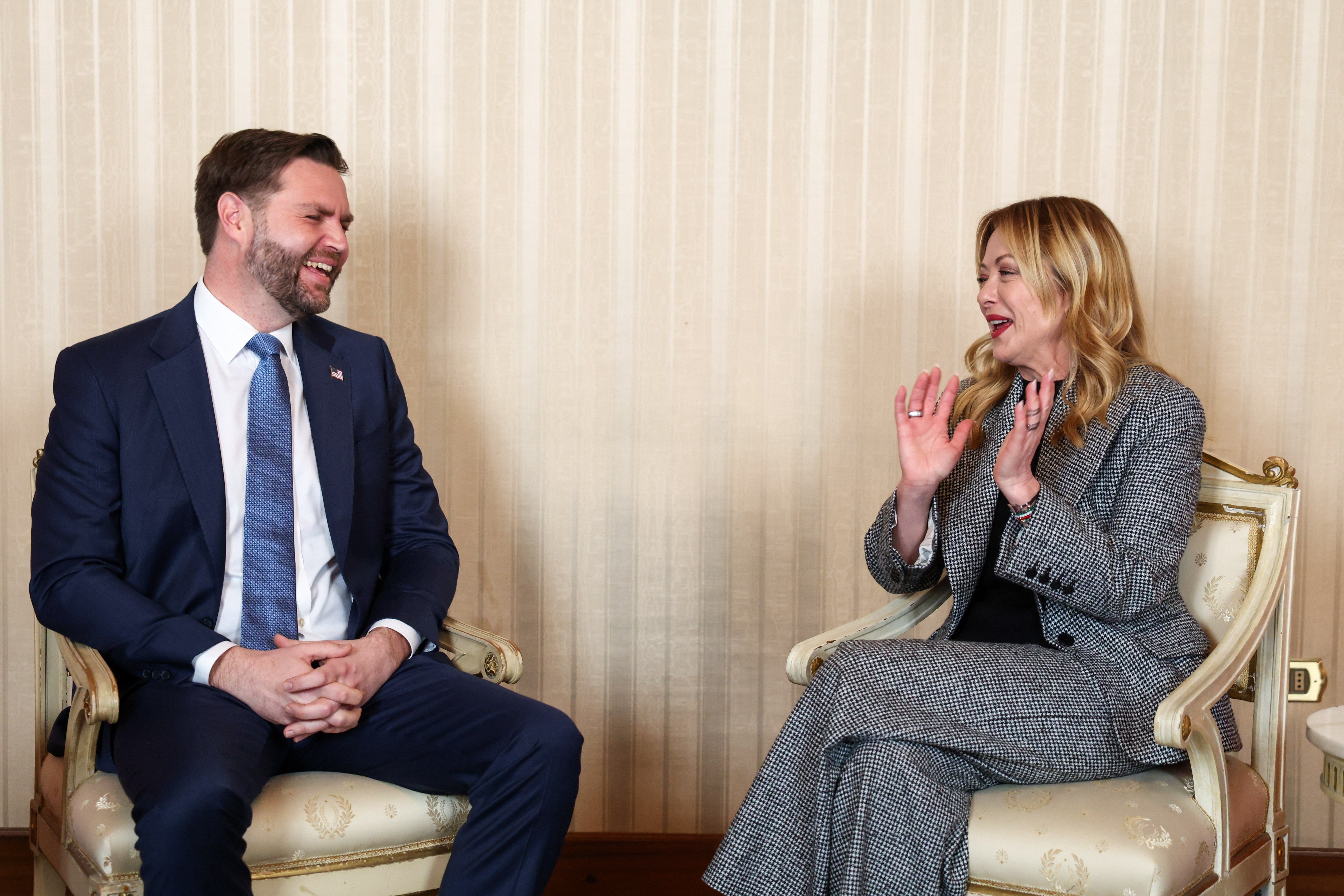
Yet, the central dilemma remains: How does one succeed a figure as outsized as Trump? The answer may lie in the playbook of Italian Prime Minister Giorgia Meloni, who managed to inherit and transform the movement of another larger-than-life populist, Silvio Berlusconi.
Meloni's journey began as a minister in Berlusconi's government, but she recognized early on that his personality-driven politics could not be replicated. Instead, she rebranded the conservative movement, co-founding the Brothers of Italy party and focusing on a policy agenda that retained populist elements while adding a cultural and religious dimension. Her strategy paid off, culminating in her election as prime minister in 2022.
Meloni's success offers a template for Vance. By adopting a straightforward, no-nonsense governing style and pairing it with a clear policy vision, she was able to unite the Italian right and achieve lasting popularity. Vance, who shares Meloni's direct approach and policy priorities on immigration, trade, and national sovereignty, could similarly redefine the MAGA movement for a post-Trump era.
However, the task is not without obstacles. Trump's personality remains a dominant force in American politics, and his base is fiercely loyal. Vance must navigate the delicate balance of honoring Trump's legacy while establishing his own identity. As the midterms approach, his ability to rally the base without relying on Trump's charisma will be tested. Some recent rallies have shown the GOP's jitters, as seen in Mississippi's Senate race, where Trump's presence was needed to shore up support.
Moreover, Vance's stance on international issues, such as his skepticism of NATO and his criticism of U.S. involvement in Ukraine, could either galvanize the base or alienate moderate voters. His position on Russia sanctions has already drawn bipartisan fire, highlighting the risks of straying from the mainstream.
Ultimately, Vance's success will depend on his ability to transform the MAGA movement from a personality-driven phenomenon into a durable political ideology. By following Meloni's example, he can build a coalition that transcends Trump's individual appeal. The question is whether he has the political acumen to do so, and whether the GOP is ready for a leader who may not dominate the news cycle the way Trump did.