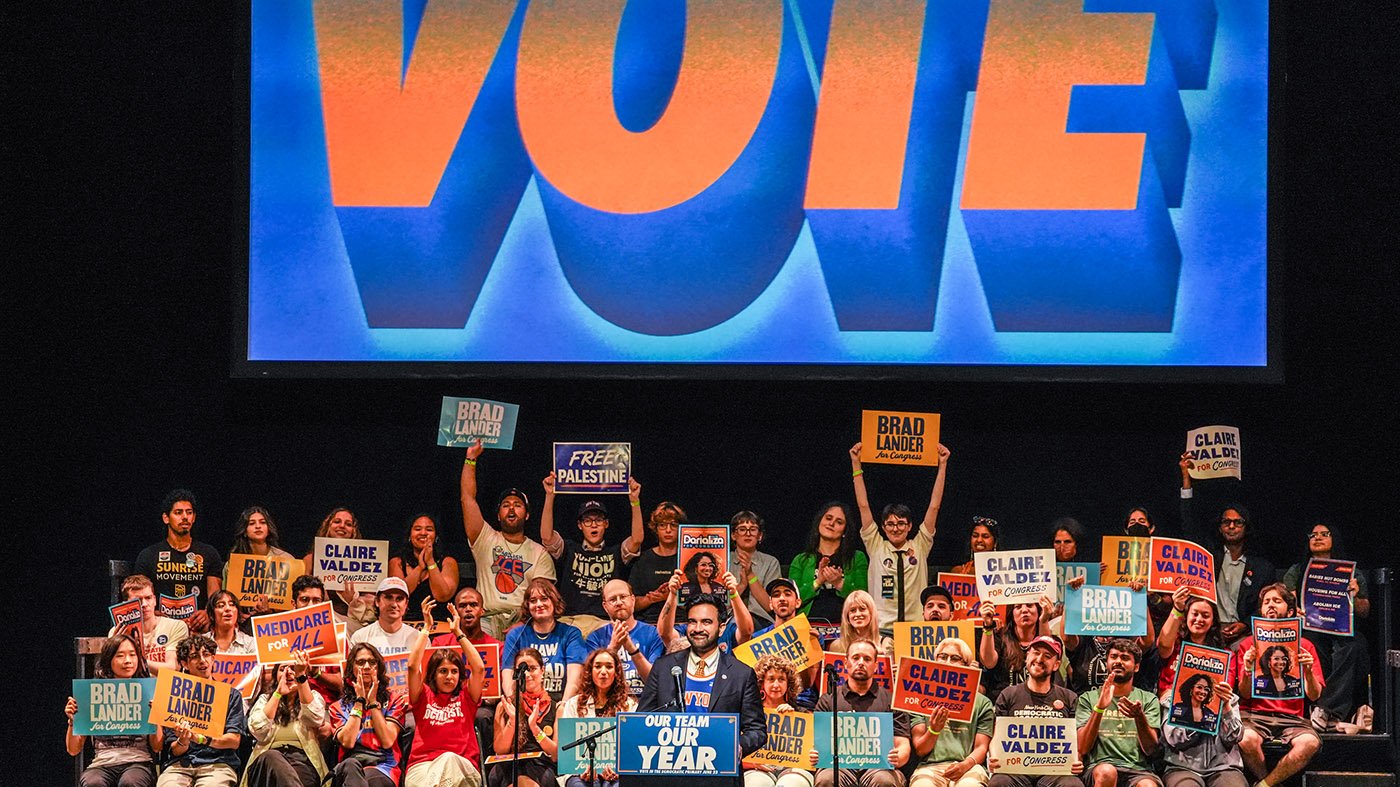
The democratic socialist movement is flexing its muscle across the country, scoring a string of primary victories that are rattling the Democratic establishment and reshaping the political landscape ahead of the midterms.
New York City Mayor Zohran Mamdani’s historic election last year put the movement in the national spotlight, joining figures like Rep. Alexandria Ocasio-Cortez (D-N.Y.) and Sen. Bernie Sanders (I-Vt.). Now, a democratic socialist is poised to win the mayor’s office in Washington, D.C., and another advanced to the mayoral runoff in Los Angeles. In New York, two Mamdani-endorsed candidates won their congressional primaries, one of whom ousted a top House progressive—a clear sign of the movement’s growing strength.
Proponents of democratic socialism are pushing for a fundamental shift away from what they call capitalist-led governance, advocating for progressive change and a rejection of the profit-driven status quo. The Democratic Socialists of America (DSA), the grassroots organization behind many of these candidates, is expanding its political machine as it looks toward the 2026 and 2028 elections.
DSA’s Vision: Transforming Society
The DSA’s goal is to “transform” American politics by centering the working class, promoting economic equality, and dismantling existing capitalist structures. “We’re out to transform society in a very basic way across the board, but we want to do it with everybody making decisions together as much as possible,” Ashik Siddique, co-chair of the DSA, said in an interview.
The DSA is primarily a nonprofit activist group, not a political party, but it serves as the main organizational engine for the movement. Some candidates align with democratic socialist ideals without being formal members. On its website, the DSA describes democratic socialism as a system where “ordinary people have a real voice in our workplaces, neighborhoods, and society,” and calls for collective ownership of key economic drivers like energy and transportation. Its platform includes Medicare for All, police defunding, and the Green New Deal.
“People want to expand high-quality public transit, universal childcare, and raise the minimum wage to a living wage,” Siddique said. “These policies are very popular when people hear they’re on the table.”
As a candidate, Mamdani championed rent freezes, universal childcare, free city buses, and city-owned grocery stores. In D.C., the local DSA chapter is pushing for alternatives to policing, criticizing the current mayor’s collaboration with Immigration and Customs Enforcement. Progressive mayoral nominee Janeese Lewis George has promised aggressive resistance to federal overreach, drawing a warning from President Trump that the government could “take back” D.C. if a “crazy socialist” wins this fall.
In Los Angeles, DSA-backed mayoral candidate Nithya Raman has pledged progressive solutions to homelessness and housing costs. The Los Angeles DSA chapter, which hasn’t yet endorsed in the mayoral race, aims to defund the police and abolish prisons. Ocasio-Cortez remains a key proponent of the Green New Deal, a sweeping environmental and economic reform package.
The DSA has also taken a critical stance toward the U.S. Constitution, stating in a 2024 document that it “establishes a political order explicitly designed to enshrine rule by elites.” The group’s long-term vision includes a new democratic constitution based on proportional representation, an end to money in politics, and full voting rights for noncitizens and those with criminal convictions. It also calls for D.C. statehood, abolishing the two-party system, increasing the number of House seats, and electing the president by popular vote. A recent report from the City Journal, a publication of the right-leaning Manhattan Institute, suggested the DSA may be considering even more radical changes, including scrapping the Senate and defunding the Defense Department. Siddique called those plans a “preliminary version of edits” to the platform, with a final version coming “soon.”
“A broader long-term vision for what a democratic socialist society looks like should not be confused with shorter-term visions of governance,” he said. “For that, look to our candidates’ actual platforms.”
The DSA’s recent primary wins have deepened the Democratic rift over strategy and ideology. In New York, the victories signal a new front in the party’s internal civil war, particularly over issues like Israel. The surge also comes as Trump’s approval ratings sink, with his net approval underwater by 20 points as democratic socialists gain momentum.
With the 2026 and 2028 elections on the horizon, the DSA’s growth shows no signs of slowing. “Our growth has been on an exponential curve in recent years,” Siddique said. The movement’s ability to turn primary wins into lasting political power will be tested in the coming cycles.