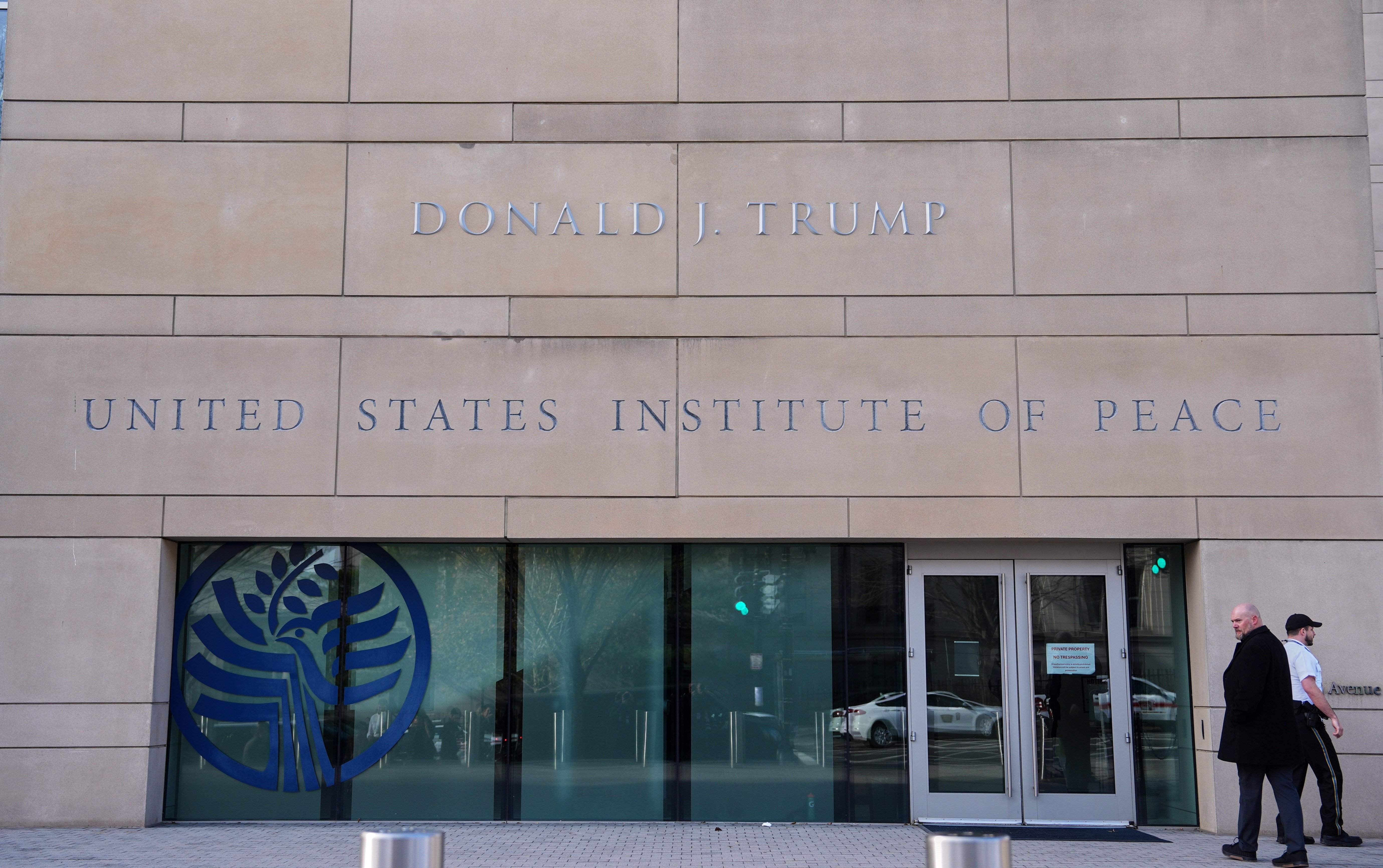
Former members of the U.S. Institute of Peace's board of directors have taken legal action to prevent the Trump administration from permanently affixing President Trump's name to the institute's headquarters in Washington, D.C. In an emergency filing Thursday with the U.S. Court of Appeals for the D.C. Circuit, the former board members' attorneys argued that the administration's plan to carve Trump's name into the building's facade would cause “serious irreparable harm” and should be halted while the broader legal dispute over the institute's fate continues.
The filing seeks a modification of the current stay pending appeal, asking the court to preserve the status quo until the case is resolved. The attorneys emphasized that the carving is a “discrete act” that can be prevented with a limited court order. The president's name was already added to the building's exterior in removable silver lettering in December, but the institute's name is permanently etched into the stone facade.
The move is part of a wider pattern by the Trump administration to assert control over cultural and historical institutions in the capital. The president has similarly sought to leave his mark on the Kennedy Center, where he fired half of the board, installed himself as chair, and pushed to add his name to the building. A federal judge blocked that renaming effort on Tuesday, prompting Trump to announce the center would close for “Reconstruction.”
The U.S. Institute of Peace, created by Congress in 1984, receives federal funding for its programs, but its headquarters was built with a combination of private donations and government money. The former board members' legal team stressed that the building is “largely funded by private donations” and is a “work of expressive architecture” symbolizing the institute's independent mission.
The institute was among the many organizations targeted for cuts by Elon Musk's Department of Government Efficiency, an effort that has sparked ongoing litigation. The former board members argue that the administration's actions, including the attempted renaming, are part of an overreach that undermines the institute's independence.
The emergency petition is the latest development in a legal battle that has drawn attention from Democrats urging Congress to curb executive power. The case also highlights tensions between the administration and federal courts, with some Senate Republicans expressing discomfort with Trump's attacks on the judiciary.
The White House has not yet responded to requests for comment on whether it plans to proceed with the engraving. The former board members' filing warns that allowing the carving to go forward would set a dangerous precedent, effectively rewriting the institute's identity to reflect the current president's personal brand.
Legal experts note that the emergency petition is a procedural move designed to prevent an irreversible action while the courts consider the merits of the case. The D.C. Circuit has not yet set a timeline for a ruling, but the urgency of the request suggests the administration may be moving quickly to complete the engraving.
The dispute over the Institute of Peace is one of several flashpoints in the broader clash between the Trump administration and independent federal agencies. As the administration continues to narrow protections for other federal entities, the outcome of this case could have implications for how much control presidents can exert over congressionally established institutions.
For now, the former board members are seeking a narrow court order to keep Trump's name off the facade until the legal questions are settled. Their attorneys argue that the building's architecture is meant to symbolize the institute's nonpartisan mission, and that carving the president's name would permanently alter that symbolism.
The case is being closely watched by advocates of government transparency and institutional independence, who see it as a test of whether the courts will check executive overreach. A ruling in favor of the former board members could reinforce limits on presidential power over independent agencies, while a ruling for the administration might encourage similar efforts at other institutions.