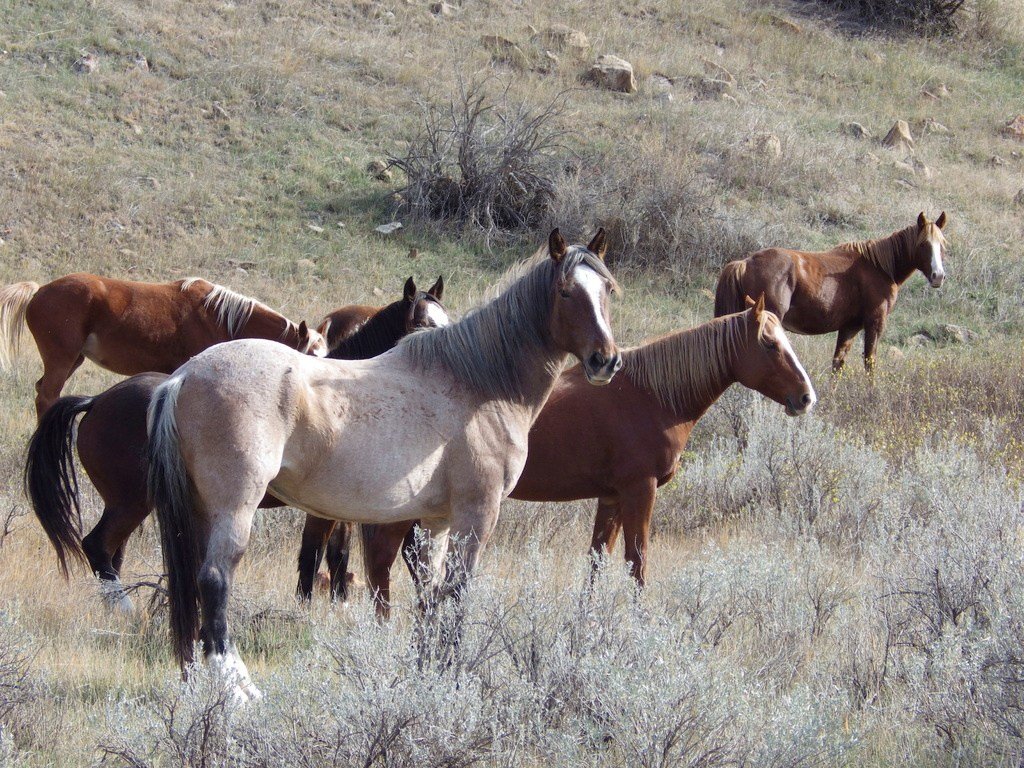
Congress has long maintained that federally protected wild horses should not be slaughtered. But a loophole in the Bureau of Land Management's sale program is threatening that promise, and a bipartisan coalition of lawmakers now wants an independent watchdog to investigate.
In September, 18 lawmakers—led by the co-chairs of the Congressional Wild Horse Caucus and Sen. Cory Booker (D-N.J.)—sent a letter to the Government Accountability Office requesting a review of BLM's Wild Horse and Burro Sale Program. The lawmakers want the GAO to examine purchaser screenings, post-sale oversight, and enforcement, including whether the agency can identify repeat violators and recover animals that end up in the slaughter pipeline.
The request follows a New York Times investigation that found BLM sold roughly 3,700 wild horses in 2025—more than double the prior year's total. Some of those animals later appeared at auctions tied to slaughter buyers. In 2026, BLM events advertised sale-eligible horses for as little as $25, a price low enough to make quick resale profitable.
The legal framework is clear on paper. The Wild Free-Roaming Horses and Burros Act of 1971 protects these animals from "capture, branding, harassment, or death," and Congress has repeatedly barred the use of appropriated funds to destroy healthy wild horses or conduct sales that result in their processing into commercial products.
But a 2004 amendment directs BLM to sell certain animals—those older than 10 or unsuccessfully offered for adoption at least three times. Once sold, the animal is no longer legally considered a wild horse. BLM acknowledges it does not track animals after sale because they have left its jurisdiction. Federal protection ends precisely when oversight may matter most.
Buyers must sign paperwork promising humane care and certifying they will not knowingly transfer an animal to anyone intending to send it to slaughter. A knowingly false statement to the federal government can violate U.S.C. § 1001, which carries a maximum prison term of five years. But a form cannot follow a horse to auction. Someone has to check.
BLM has responded with updated policies: a standard $125 price, generally limiting buyers to four animals every six months, strengthening the bill of sale, and allowing officials to bar purchasers linked to kill pens or commercial processing. Those are sensible changes, but they fall short. A horse can fetch up to $750 or more for illicit resale at a slaughter plant—a lucrative flipping operation at the expense of a life. Most importantly, BLM has yet to mandate post-sale oversight.
The debate over wild horse management has long pitted ranchers, environmentalists, and advocates against one another on questions of herd size, rangeland health, and humane population control. Those disagreements are legitimate and deserve honest debate. But loopholes that undermine federal protections should not be part of the equation. Congress has taken a first step by requesting the GAO review. Now it must follow through, using the findings to close oversight gaps and ensure that the promise of protection survives the sale.
Manda Kalimian is the founder and president of Rewilding America Now, a nonprofit that advocates for conservation-based approaches to managing America's wild horses.