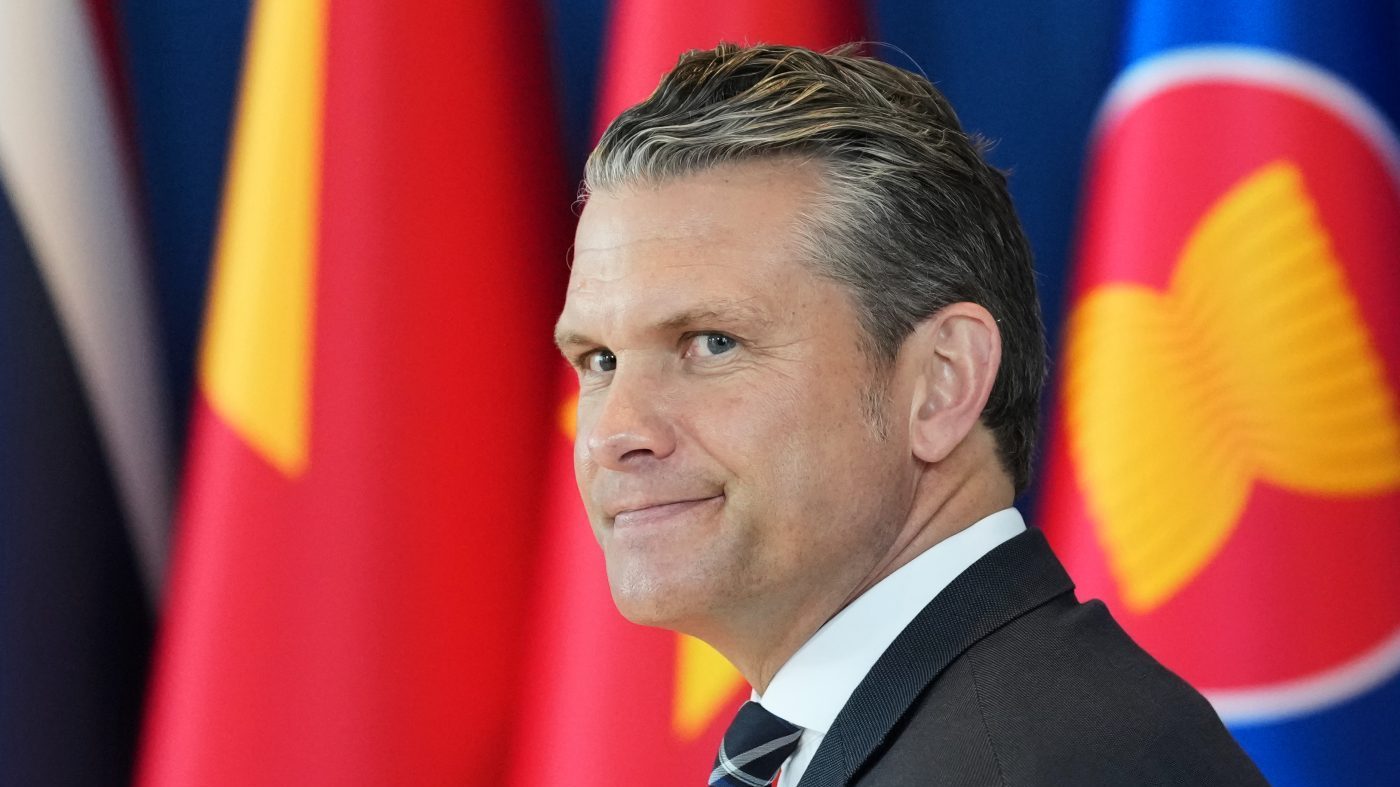
Defense Secretary Pete Hegseth used a trip to the Philippines this week to reassure Southeast Asian allies that Washington remains fully invested in the region, unveiling a new defense framework designed to guide cooperation over the coming years. Speaking at the U.S.-ASEAN defense ministers' meeting in Cebu, Hegseth described the Trump administration's approach to the Indo-Pacific as “strong, quiet and clear,” signaling a willingness to defend American interests and those of its partners.
“That is, by definition, peace through strength. And we’re ready and willing to work with all of you where you are based on your own circumstances and your own priorities and shared mutual interest thereafter,” Hegseth said at the opening of the gathering.

The Pentagon chief's appearance comes as Indo-Pacific allies continue to scrutinize U.S. reliability, particularly in light of the ongoing U.S. military campaign against Iran, now in its seventh month. Hegseth emphasized that stronger ties with regional partners would improve interoperability, maritime domain awareness, and naval cooperation between U.S. and allied forces.
“Serious partners train together, learn together, plan together and build the confidence and competence necessary to prevent conflict,” Hegseth said, acknowledging the diverse perspectives within ASEAN. “We’re not going to agree on everything, nor do we need to. But an agreement on the fundamentals is enough to support practical cooperation where our shared interests are overlapping and are clear, and that’s the type of cooperation the Department of War will continue to pursue with our ASEAN partners.”
While Hegseth offered few specifics about the new defense framework, he indicated it would shape collaboration for the next several years and that the U.S. stands ready to work with Singapore, which will assume the chairmanship of the ASEAN Defense Ministers’ Meeting-Plus (ADMM-Plus). The assurance is particularly significant for the host nation, the Philippines, which has seen escalating tensions with China over maritime and territorial claims in the South China Sea and the Luzon Strait, with both sides deploying aircraft and vessels to assert their positions.
Gregory B. Poling, who leads the Southeast Asia Program and the Asia Maritime Transparency Initiative at the Center for Strategic and International Studies, said Hegseth’s remarks would be “well received.” He noted that simply showing up at the ADMM-Plus meeting without making any alarming statements “counts for a lot at the moment.”
“I’m sure the Philippines would have liked some more clear language on the South China Sea or Mutual Defense Treaty, and perhaps that will still come,” Poling told The Hill on Wednesday. As for the U.S.-ASEAN framework, Poling characterized it as “floating a trial balloon more than a fully-fleshed-out proposal,” adding, “But we’ll have to wait for Singapore’s ASEAN chairmanship next year to see if we hear about it again.”
The visit also comes amid domestic political pressure on Hegseth, with some lawmakers calling for his ouster over policy disagreements and the handling of the Iran conflict. Meanwhile, the Pentagon has faced scrutiny over issues ranging from Starlink operations in Ukraine to internal betting policies, though Hegseth’s focus in Cebu remained on regional security.