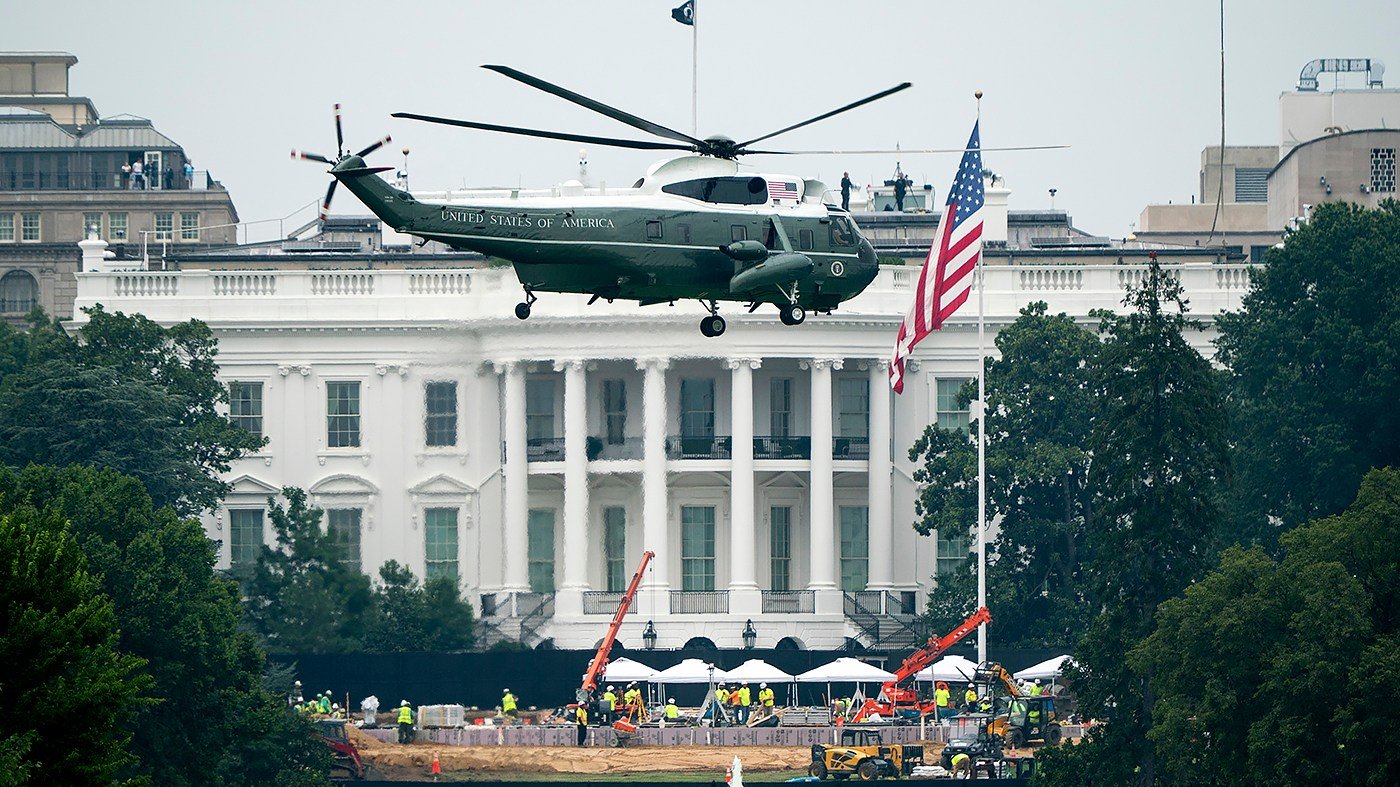
The National Transportation Safety Board (NTSB) on Thursday released a preliminary report attributing a near-collision between President Trump's Marine One helicopter and a commercial airliner to the temporary relocation of the Ellipse landing site. The incident, which occurred on August 4, saw the presidential helicopter come within approximately 0.82 miles laterally and 700 feet vertically of a passenger jet near Reagan Washington National Airport (DCA).
According to the report, Marine One (VM1) attempted to contact air traffic controllers at DCA twice around 2:31 p.m., but neither transmission was received. The first attempt failed to reach the control tower, and the second was described as "broken and completely unreadable." The helicopter also tried to relay the standard three-minute liftoff warning through the helicopter facility at Joint Base Anacostia-Bolling, but that attempt was unsuccessful as well.
The three-minute warning is a critical protocol designed to give air traffic controllers enough time to clear airspace for presidential movements. The failure to establish communication meant that the airspace was not cleared in time, leading to the close encounter with the passenger jet.
An analysis by Federal Aviation Administration (FAA) engineers found that the radio transmitter/receiver site lacked adequate line-of-sight to the Ellipse, preventing reliable communication. The Ellipse site had been moved in July due to ongoing construction on the White House Helipad, which has been closed since May when President Trump began construction of an arena for the UFC Freedom 250 fight.
The report also noted that prior to the incident, air traffic control had conducted radio checks at the new Ellipse site with two separate Marine Helicopter Squadron One helicopters, though it did not specify whether those checks revealed any issues.
In the days following the incident, the White House insisted that President Trump was never in danger. White House spokesman Kush Desai reiterated that confidence, stating, "Marine One flights are piloted by the finest aviators in the world, and the White House maintains the utmost confidence in these patriots and other security officials who are responsible for ensuring the President's safety." He added that the White House continues to work with military, FAA, and other security personnel to ensure the President's safety.
This incident comes amid broader scrutiny of aviation safety and presidential travel protocols. The NTSB's findings highlight the importance of reliable communication systems, especially when temporary changes are made to established procedures. For more on related security measures, see the recent honors for Marines and changes in military exercises.
The FAA and the NTSB are continuing their investigations, and the White House has not indicated whether the Ellipse site will be moved again or if additional communication safeguards will be implemented.