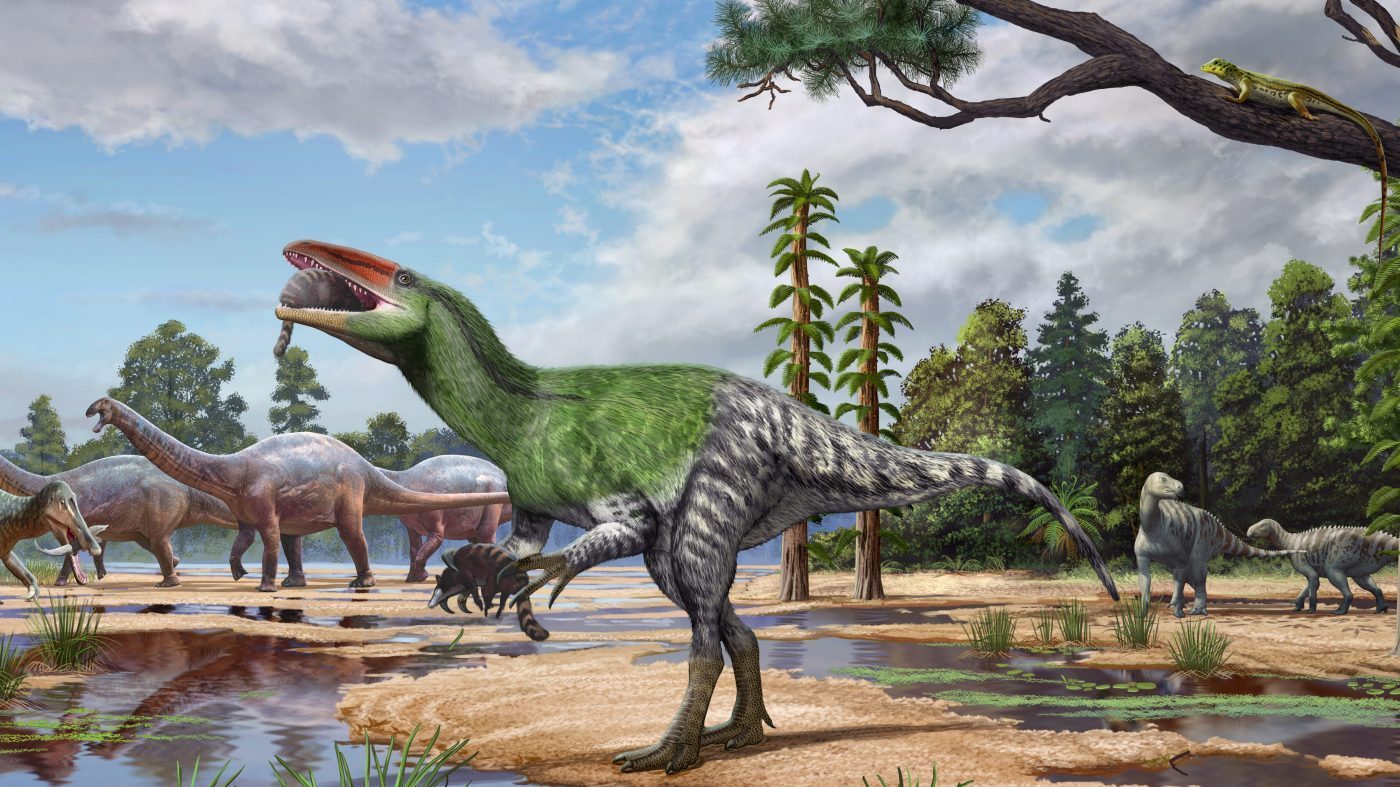
A fossil that sat unnoticed in a London museum for nearly a century has finally been identified as a new species of dinosaur, researchers announced this week.
The creature, named Invictibellatrix amberina, was recognized from a skull fragment housed at the Natural History Museum. The fossil was originally collected by amateur paleontologist Reginald Walter Tooley at the base of a cliff on the Isle of Wight. After Tooley died in 1924, the museum acquired the specimen along with more than 1,000 other finds from his collection.

Lead author Dr. Cassius Morrison, who led the study published in Royal Society Open Science, called the oversight puzzling. “It is a real mystery that this fossil was overlooked for so long, sitting in a drawer for nearly 100 years,” he said in a press release.
Using CT scans, researchers generated 3D images of the skull and the cavity that once held the dinosaur’s brain. Comparing these images with those of other meat-eating dinosaurs revealed distinct features, including an oval-shaped opening where the spinal cord met the brain and an hourglass-shaped ridge. These anatomical differences were enough to classify the specimen as a new species.
Invictibellatrix belonged to a group of theropods known as megaraptorans, relatives of the tyrannosaurs. It had a long, narrow skull, small arms, and likely sported feathers. Its claws measured between 4 and 8 inches long. The dinosaur was relatively small for a megaraptoran, reaching only about 10 to 13 feet in length and standing roughly 5 feet tall at the hip, making it one of the smallest and earliest members of its group discovered to date.
The species lived about 120 million years ago in what is now the United Kingdom. Its name translates to “unconquered female warrior,” a nod to the group’s later dominance as apex predators.
While Invictibellatrix was not the top predator of its ecosystem, Morrison emphasized that it would have posed a real threat to humans. “It was not the apex predator of its time, but for humans this dinosaur would have been more dangerous than a T. rex,” he said. “We would have been perfectly sized prey, about a third of their body weight. They definitely would have chased us. A T. rex would not have bothered, as we would have been too small.”
The discovery sheds new light on the diversity of early megaraptorans and underscores the value of revisiting museum collections. As paleontologists continue to re-examine long-stored specimens, similar finds may emerge, offering fresh insights into prehistoric life.