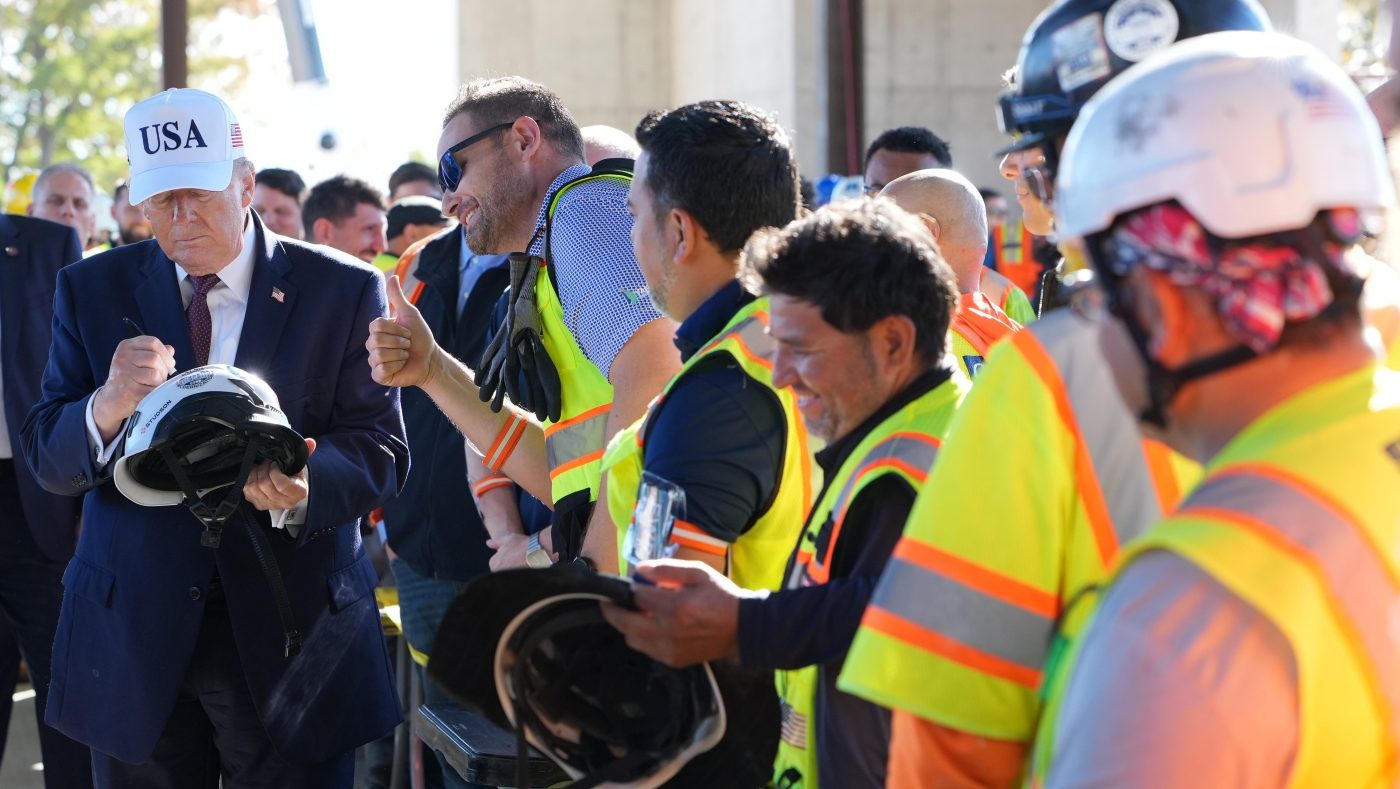
President Trump made his first public appearance since the Republican Party's decisive midterm defeat on Wednesday, choosing a construction site over a concession speech. Standing in the partially built White House ballroom, Trump signed the final steel beam alongside workers and officials, then watched as it was hoisted into place. He did not address the election results until reporters pressed him, when he weighed in on Vice President Vance's claim that the Iran war cost the GOP the midterms.
Trump described the ballroom as "the most powerful building structurally...they say ever built and it was designed that way so the president can have safety." He called it "the dream of presidents...for 150 years" and insisted the project is ahead of schedule and under budget—a claim he has repeated frequently. Defending the renovation, he said, "When I get criticized, like, 'Why are you working on the White House?' I'm doing it because the White House is the ultimate symbol of America. And it's got to be pristine. It's got to be perfect."
The president also touted other planned projects, including the Triumphal Arch, a new helipad on the North Lawn, the National Garden of American Heroes, and renovations to the East Potomac Golf Links. He called the ballroom "a very important space in the future life of our country."
When asked about Vance's statement on X that the Iran war drove Republican losses, Trump said, "I think it's largely true because it drove the gasoline up a little bit short term." He defended the conflict, saying, "I mean, well, you have no choice," and called it "worth it." The war's unpopularity has been cited as a key factor in the GOP's midterm collapse, with anti-war voters staying home.
The midterm results handed Democrats control of both the House and Senate, a major rebuke to the administration. Trump said he would "get along probably" with Democratic leaders "unless they want to be destructive," but quickly added, "I have the power of the veto." He noted he had already spoken with some Democrats.
On the upcoming House Republican leadership race, following Speaker Mike Johnson's decision not to run, Trump said he would "stay out of" the contest. The GOP's losses have also fueled internal criticism, with some officials like Oklahoma City's mayor blasting the party as "morally and intellectually bankrupt" after the election.
The president's focus on construction projects in the wake of a political defeat drew sharp contrasts. While Democrats celebrated their gains, including a record expansion of the Hispanic Caucus, Trump remained fixated on the physical legacy of his presidency. His remarks did little to address the policy questions that dominated the campaign, such as the economy and the Iran war.
Political analysts noted that Trump's decision to avoid direct acknowledgment of the losses until pressed was characteristic of his approach to setbacks. The ballroom event, which was streamed live, served as a backdrop for his first public message since the election—a message centered on his vision for the White House rather than the political landscape.
As the new Congress prepares to convene, the president's veto threat signals a confrontational path ahead. Whether he can find common ground with Democrats remains uncertain, but his immediate priorities appear to be the ongoing renovations and the symbolic power of the presidency.