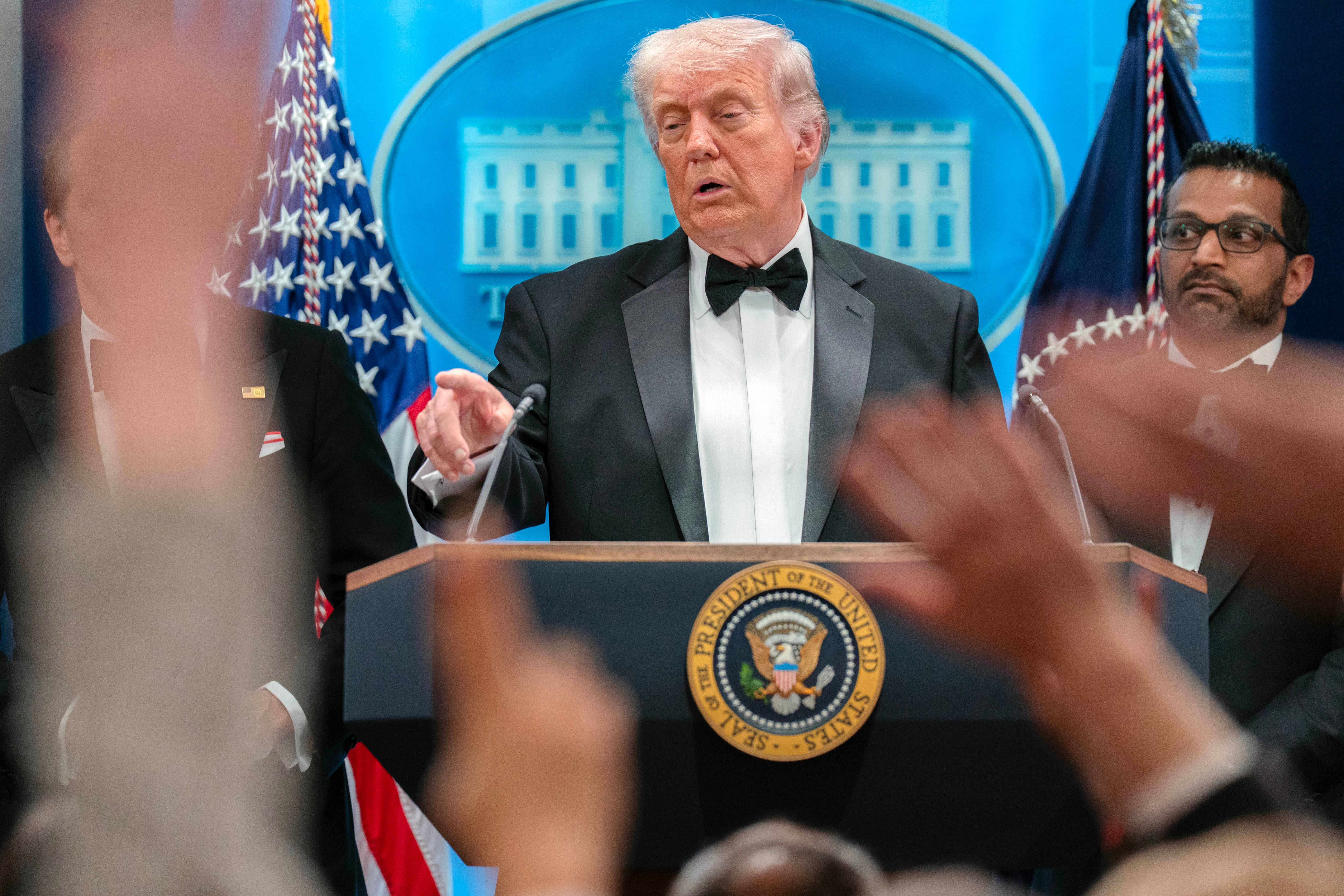
The shooting at the White House Correspondents’ Dinner Saturday night dominated headlines, with predictable focus on the suspect’s identity, motives, and the Secret Service’s swift evacuation of President Trump, Vice President Vance, and other officials. Trump later told reporters, “I’m not a basket case. I really take it as it is. I do it for the country,” and called CBS News’ Norah O’Donnell “a disgrace” and “horrible people” for questioning him about the suspect’s writings.
No one was physically harmed, but the damage to the First Amendment may prove fatal. The WHCD, an Oscars-style gala hosted by the White House Correspondents’ Association, has been attended by every president since Calvin Coolidge—including Trump, who skipped it during his first term. This year, he attended after being welcomed with “Hail to the Chief” and an agreement to forgo a traditional comedian. The irony was grotesque: Trump has used the presidency’s coercive powers to bully, intimidate, and diminish journalistic freedom more savagely than in his first term.
The WHCA, founded in 1914, claims to represent over 250 outlets and 900 reporters “fighting for the broadest access to officials, policies, events, and trips.” Its mission echoes the First Amendment’s core ban on government abridging press freedom. Yet the dinner’s business-as-usual tone suggests much of legacy media is normalizing a presidency that poses a profound danger to democracy.
Soon after retaking office, Trump banned Associated Press journalists from the White House and Air Force One for refusing to call the Gulf of Mexico the “Gulf of America.” He reshaped the press pool to elevate friendly outlets like Breitbart, Newsmax, and One America News Network.
Through defamation and censorship lawsuits, Trump extracted $56 million in settlements from ABC News over George Stephanopoulos’ comments on the E. Jean Carroll verdict; from Paramount Global (CBS) over a 60 Minutes piece on Kamala Harris; and from Meta for suspending his account after the Jan. 6 Capitol riot. He also sued the New York Times, four reporters, and Penguin Random House; the Wall Street Journal and Rupert Murdoch; the Des Moines Register and Gannett over a 2024 poll; and the Pulitzer Prize Board over 2016 Russia stories.
Defense Secretary Pete Hegseth imposed new Pentagon coverage rules, claiming journalists threaten classified information, and ordered outlets like CNN, The Hill, The Washington Post, The New York Times, NBC News, Politico, and NPR to vacate their dedicated offices—most now cover the Pentagon off-site. FBI Director Kash Patel filed a $250 million defamation suit against The Atlantic over an article about his alleged alcohol abuse, and also sued former FBI official Frank Figliuzzi over MSNBC comments. Richard Grenell, former acting Kennedy Center director, sued Olivia Troye, a former Pence aide, over a social media post.
FCC Commissioner Brendan Carr reinstated complaints against ABC over debate moderation, threatened to revoke licenses over Iran war coverage, opened investigations into NPR and PBS, and probed a San Francisco radio station for reporting on immigration raids. Two journalists, including former CNN anchor Don Lemon, have been indicted over their coverage of an anti-ICE rally in Minneapolis.
While many of these suits have been resolved against Trump, the chilling effects and personal costs of litigation are undeniable. The WHCA’s pledge to ensure independent reporting on the presidency rings hollow as Trump’s attacks on the free press intensify, threatening the very foundation of American democracy.