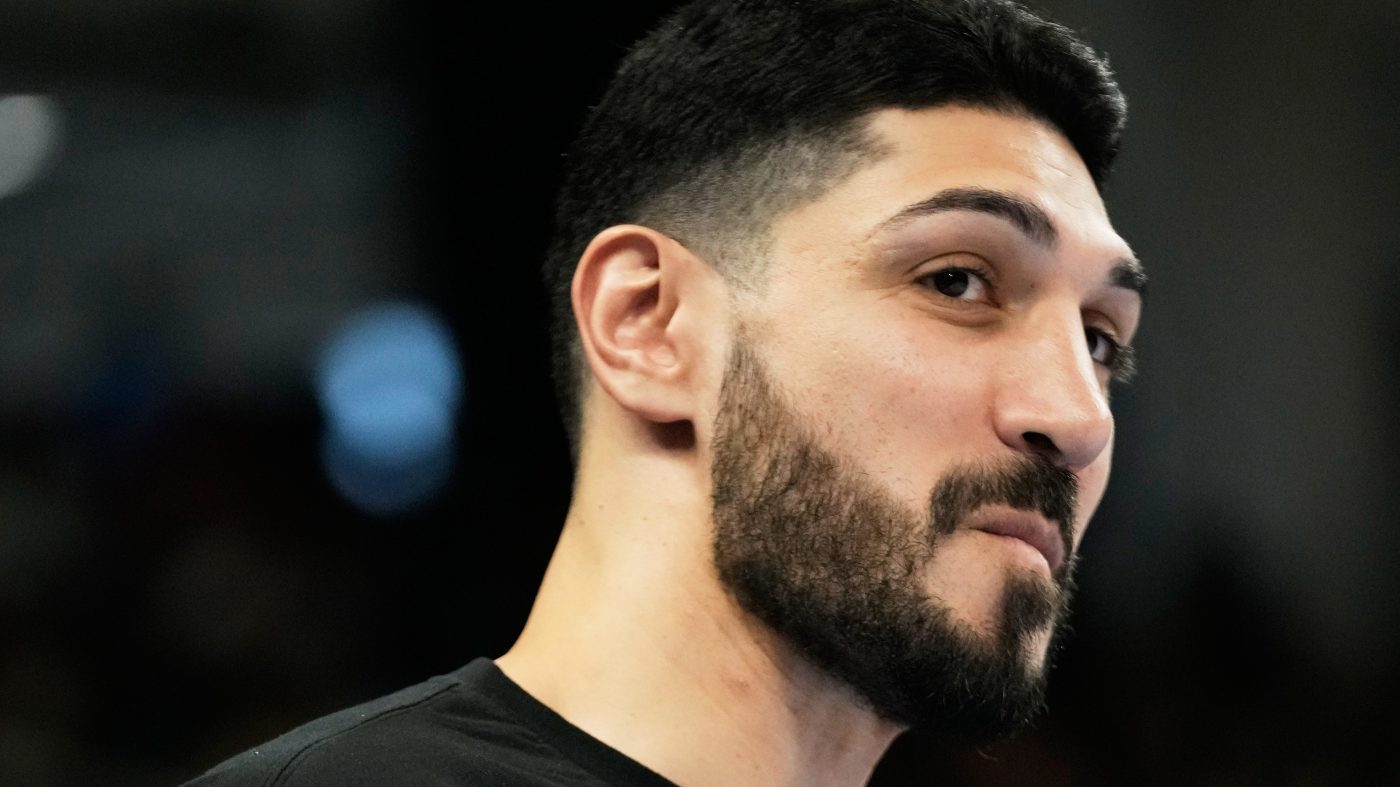
The Chicago Sky have barred former NBA player Enes Kanter Freedom from their home arena following a heated exchange with one of the team's players during a weekend game. Team owner Michael Alter announced the decision on Tuesday, saying Kanter would not be allowed inside Wintrust Arena unless he demonstrates he can follow team rules without posing a risk.
Alter told reporters that Kanter's presence had become untenable after the incident on Sunday, when he was ejected from the arena after a verbal confrontation with Sky guard Natasha Cloud. "It was pretty clear to us that his purpose of coming here was trying to be provocative and just see how much attention he could get and stir up and create," Alter said, according to the Associated Press.
The ban comes as Kanter, who has reinvented himself as a political activist, thrusts himself into the ongoing debate over transgender athletes in women's sports. He declared for the WNBA draft earlier this month and has publicly pressed the league to "define what a woman is," echoing a broader push by national Republicans to restrict transgender participation in female athletics.
There are currently no transgender or male athletes competing in the WNBA, but the issue has become a flashpoint in conservative circles and among some former athletes. Kanter's rhetoric has drawn both support and criticism, with some praising his stance and others accusing him of using the league as a platform for self-promotion.
After his ejection, Kanter took to social media to claim he was tossed for "supporting women," framing the incident as a defense of female athletes. His version of events, however, contrasts sharply with the account given by Sky officials, who described his behavior as disruptive and aimed at drawing attention.
Alter's decision to ban Kanter is likely to intensify the debate, as it touches on free speech, arena conduct policies, and the intersection of sports and politics. The ejection from the game has already sparked widespread discussion, with some commentators questioning whether the league and its teams are adequately prepared to handle politically charged demonstrations at games.
This is not the first time a sports franchise has taken action against a high-profile figure over political activism. In recent years, several teams have faced backlash for banning or restricting individuals whose views conflict with team or league policies. The controversy also echoes service refusal debates in other sectors, where business owners have been criticized for excluding people based on their political or social stances.
Kanter, who was born in Switzerland and grew up in Turkey, has been a vocal critic of Turkish President Recep Tayyip Erdogan and has used his platform to advocate for human rights. His transition from professional basketball to political activism has been marked by a series of high-profile stunts and statements, and his recent foray into women's sports has added a new layer of controversy.
The WNBA has not yet commented on the ban, but the league has faced increasing pressure to address the role of political activism in its arenas. Some have called for clearer guidelines on what constitutes acceptable behavior for spectators and guests, while others argue that teams should have broad discretion to maintain a safe and welcoming environment.
Alter's statement suggests that the door is not entirely closed for Kanter, but any future attendance would require a significant change in behavior. "Unless sometime in the future, he's able to prove to us to our satisfaction that he is able to abide by our rules without being a potential threat," Alter said, leaving the possibility of a future reconciliation open.
For now, the ban stands as a clear signal that the Chicago Sky are unwilling to tolerate disruptions, regardless of the political message behind them. The incident also highlights the growing tension between free expression and the operational needs of sports organizations, a tension that is likely to persist as the cultural and political climate remains polarized.