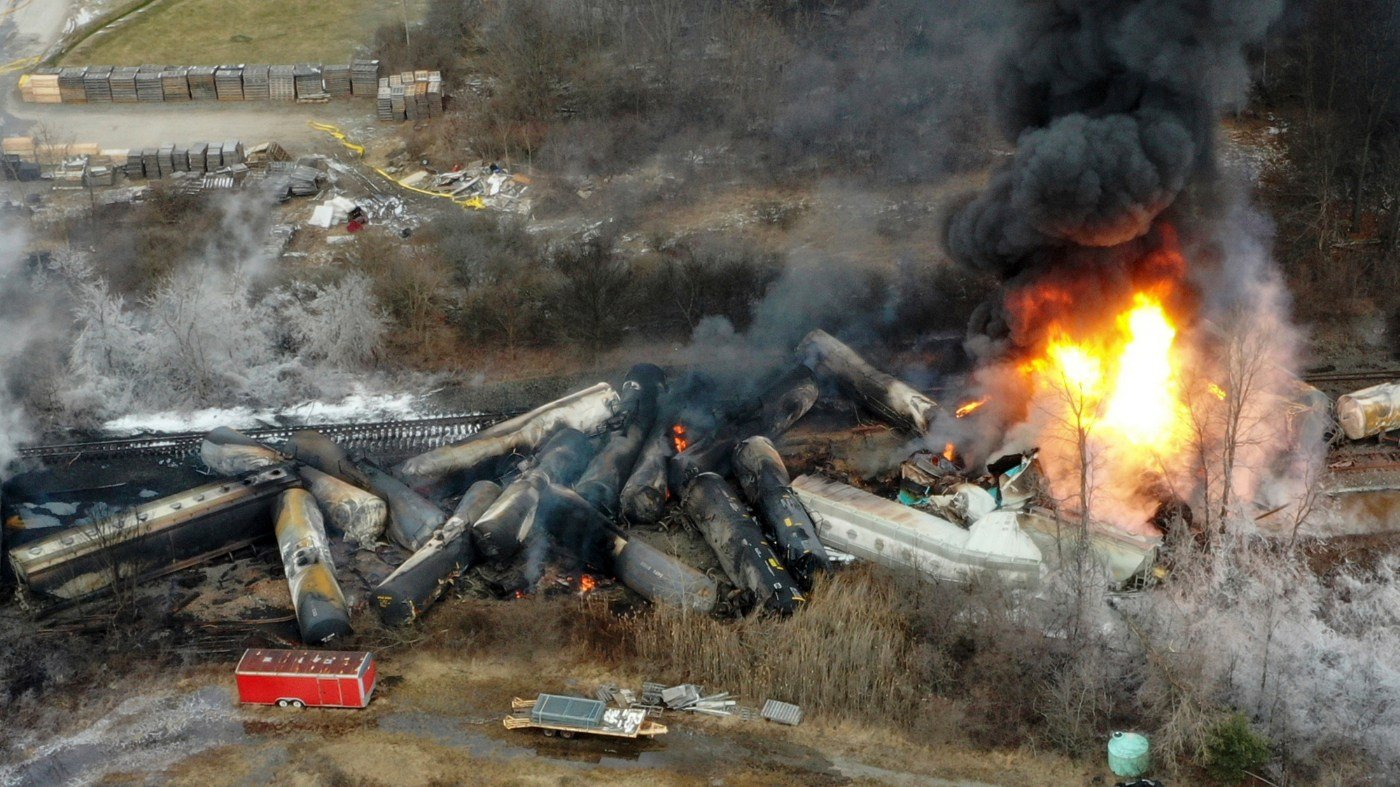
Newly obtained federal documents reveal that initial government modeling after the 2023 East Palestine, Ohio, train derailment projected that thousands of residents could have been exposed to toxic chemicals at levels capable of causing severe injury or death, according to a watchdog group that released the materials.
The documents, obtained by the Government Accountability Project, show that the day after the derailment, the federal Interagency Modeling and Atmospheric Assessment Center (IMAAC) calculated that nearly 18,000 people might be exposed to phosgene—a chemical that can cause severe respiratory damage—and that over 300 could face exposure to hydrogen chloride, both breakdown products of vinyl chloride that spilled in the accident. The model also projected that roughly 1,900 people could face potentially fatal phosgene exposure and 185 could face fatal hydrogen chloride exposure.

Those figures were never made public, despite evacuation orders being issued for nearby residents. The documents, obtained through Freedom of Information Act requests, suggest that the initial worst-case scenario was later revised downward as more data became available, but critics argue that the public should have been informed about the initial risk assessment.
“The government modeled thousands of casualties, then buried the maps and let residents walk back into the plume,” said Lesley Pacey, senior environmental officer at the Government Accountability Project. “It took a whistleblower declaration and six federal agency FOIA requests before DOD produced what the public should have been told from the beginning.”
The Environmental Protection Agency responded to the release, stating that its personnel were on-site within hours of the derailment and that the agency remained transparent through its website, welcome center, community meetings, and newsletters. The EPA spokesperson said the initial model, created at the agency’s request, assessed “an absolute worst-case scenario” and that updated models were shared with state and local officials as more information became available.
The Federal Emergency Management Agency also issued a statement, with a spokesperson saying, “We cannot speculate on prior officials’ motives, but communities facing hazardous materials incidents deserve timely, accurate, and transparent information.” The spokesperson characterized the matter as “Yet another Biden cover up at the expense of the American people,” raising questions about what the administration knew and when.
Ohio Governor Mike DeWine’s office defended the response, noting that the projections were made before evacuation orders were issued and that evacuating the area “would have dramatically reduced any potential impact.” Dan Tierney, a spokesperson for the governor, added that subsequent modeling “did not show widespread areas affected at a level that would suggest serious health consequences.”
Pennsylvania Governor Josh Shapiro’s office pointed out that the derailment occurred in Ohio, so Pennsylvania lacked jurisdiction, but noted that the initial modeling was a worst-case scenario and that later modeling showed more limited impacts.
The East Palestine incident quickly became a political flashpoint, with former President Donald Trump criticizing the Biden administration’s handling and President Biden’s delayed visit to the town. The Biden administration defended its response and blamed Republicans for lax rail regulations. The newly revealed documents are likely to reignite those debates, especially as public trust in government handling of crises remains low.
The release of these documents comes amid broader scrutiny of federal agencies’ transparency, with some lawmakers and watchdogs calling for reforms. The Government Accountability Project’s findings underscore the importance of timely public disclosure in environmental emergencies, a lesson that may have implications for how communities prepare for and respond to disasters.