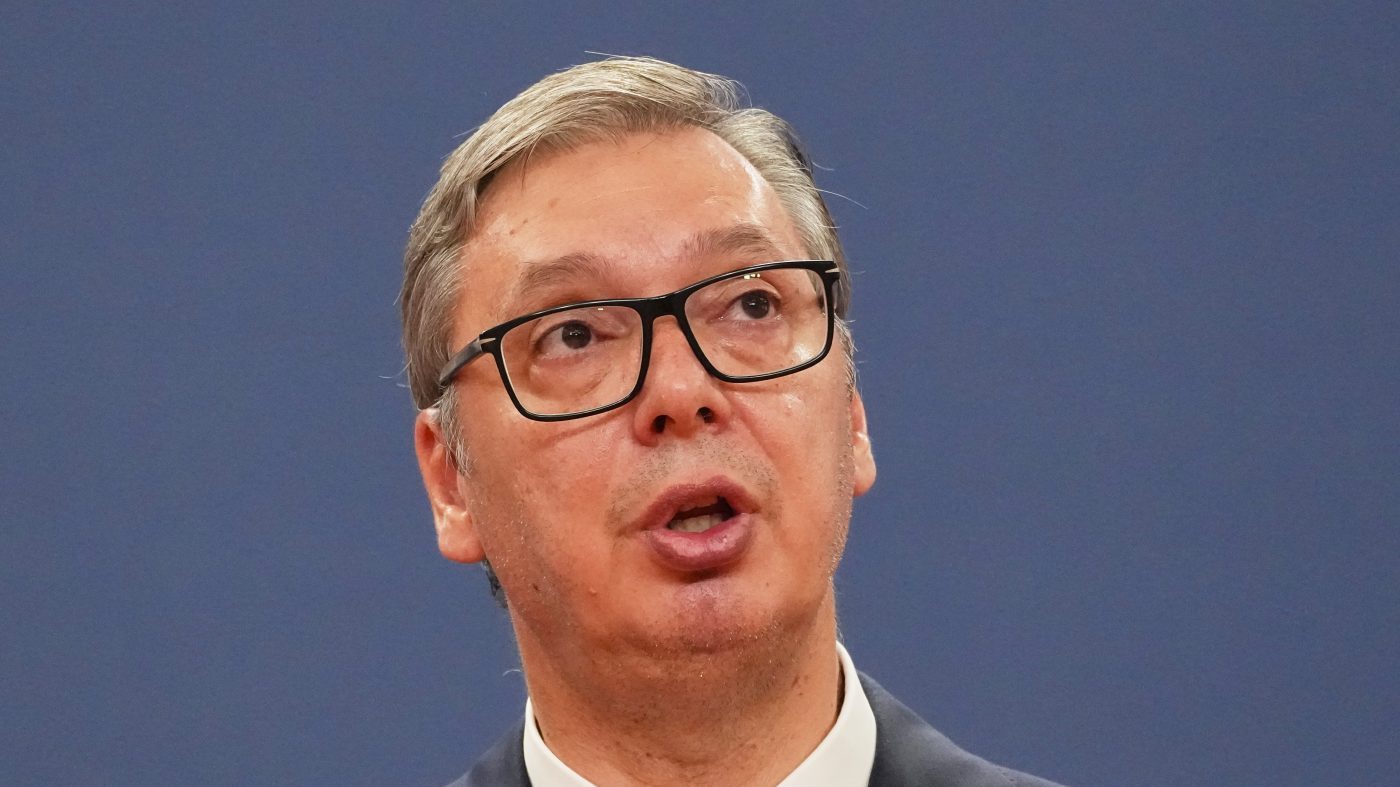
A bipartisan pair of House Foreign Affairs Committee members is escalating pressure on Serbian President Aleksandar Vučić, warning that failure to address anti-corruption demands and distance Belgrade from Washington's adversaries could trigger U.S. sanctions and visa bans.
Reps. Joe Wilson (R-S.C.) and Bill Keating (D-Mass.) introduced a bill on Thursday that would impose sanctions and visa restrictions on individuals who undermine democratic processes, peace, stability, or territorial integrity in the Western Balkans. The measure is a direct rebuke to Vučić, who has maintained a notably warm relationship with President Trump, despite the president's past efforts to broker a Serbia-Kosovo normalization deal.
The legislation aligns with ongoing student-led protests that have rocked Serbia for two years, sparked by a November 2024 railway station canopy collapse that killed 16 people. Demonstrators argue the tragedy reflects systemic government mismanagement and corruption in construction projects.
Wilson condemned Vučić's trajectory, stating, "Under President Vucic, Serbia has deliberately drifted further from Rule of Law and nearer to enemies of freedom like War Criminal Putin, the Chinese Communist Party, and the terrorist regime in Tehran." He added, "Despite widespread protest of corruption, the Vucic government threatens to destabilize the region and beyond. The people of Serbia deserve better."
Keating echoed the urgency, emphasizing that the bill signals Serbia must make tangible progress on anti-corruption and curb influence from Iran, Russia, and China. "Democracy, rule of law, and anti-corruption must remain key pillars in the U.S.-Serbia bilateral relationship," he said.
The bill text explicitly calls out Vučić's use of excessive force against protesters, demands an investigation into the railway tragedy, and raises alarms over Serbia's deepening ties with Tehran, Moscow, and Beijing. It also stresses the U.S. interest in a stable, democratic Serbia anchored in Euro-Atlantic institutions.
Vučić, who has held power for 12 years as president or prime minister, announced in late July that he would resign within weeks, with new parliamentary and presidential elections slated for October 18 or 25. However, concerns persist about the fairness of those elections. Freedom House rates Serbia as "partly free," noting that Vučić's Serbian Progressive Party has steadily eroded political rights and civil liberties, pressuring independent media, opposition, and civil society.
Despite the tension, Trump and Vučić have not met face-to-face since 2020, though they spoke by phone after Trump's 2024 election win. Vučić hosted Donald Trump Jr. twice in Belgrade this year, and in July, the U.S. and Serbia launched their first "strategic dialogue," a step seen as elevating bilateral ties.
The Wilson-Keating bill directs the Secretary of State to raise four issues in that dialogue: Serbia's relations with Russia, China, and Iran; ensuring free and fair elections; anti-corruption and rule-of-law reforms; and strengthening democratic governance, press freedom, and assembly rights. If the secretary fails to certify progress, the bill would suspend the strategic dialogue or cut related funding.
The move reflects growing bipartisan concern in Washington over Serbia's drift, even as the Trump administration has pursued closer engagement with Belgrade. For more on how lawmakers are reacting to broader geopolitical pressures, see Treasury's Iran pressure campaign and why some argue Tehran strategy falls short.