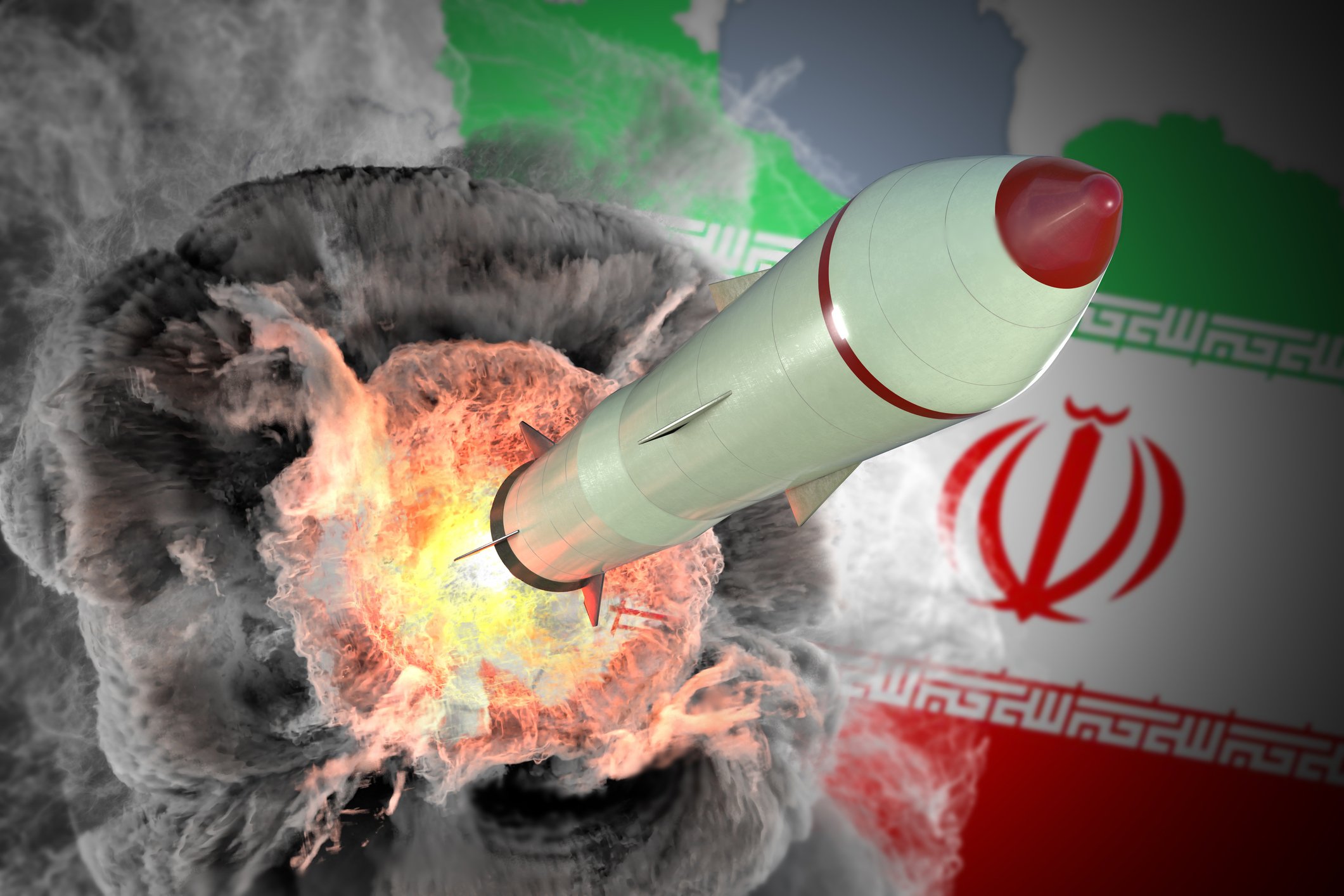
President Trump recently rejected a new offer from Iran that proposed a mutual climbdown and future negotiations. Trump correctly dismissed the proposal because, as he noted, Tehran refused to abandon its nuclear ambitions and made clear it has no intention of doing so.
That refusal is the core obstacle to any resolution. Once the U.S. and Israel demonstrated they could strike Iran at will, ending Iran's nuclear program shifted from a top strategic priority to a strategic necessity. The already slim chance that Iran's leadership would forgo developing nuclear weapons has vanished entirely.
What Would a Nuclear Iran Do?
To understand the threat, consider the two nations. Israel is a small country of 8,500 square miles, smaller than New Jersey, with about 10 million people concentrated in the northern half. Iran is nearly the size of Alaska, with over 92 million people. A single nuclear bomb would devastate Israel in a way that could never be matched against Iran. A few bombs could effectively eliminate the Jewish state, with deadly fallout spreading across the Middle East.
Would Iran actually launch such an attack? The faction ruling Iran, the Islamic Revolutionary Guard Corps (IRGC), has continuously funded terrorist groups attacking Israel and destabilizing Syria, Lebanon, Iraq, and Yemen. The IRGC has proven itself implacably violent and aggressive, completely heedless of the suffering of the Iranian people. It has spread violence and misery throughout the region with no reticence. Nothing in its history suggests it would shy away from using the ultimate weapon.
The regime's treatment of its own people is a key indicator. Mass murder and incarceration are part of its domestic control playbook. Given Iran's size and population, a nuclear Israel could not destroy the entire state and all its leadership. It is plausible that Iran's leaders might decide the losses inflicted by Israel are acceptable if the tradeoff is the end of the Jewish state.
A Less Genocidal but Still Insidious Strategy
Iran could pursue a less genocidal but still insidious strategy, leaving the entire Middle East in perpetual fear. Consider a scenario where the IRGC detonates a single device in the Negev Desert, perhaps at an Israeli military base. By launching enough projectiles to overwhelm the Iron Dome, it could sneak in a nuclear-armed missile, killing thousands whom they could claim are legitimate targets. Israel would face enormous pressure not to respond with its own nuclear strike. If Israel ignored that pressure, what would it hit? Is there an equivalent military base? Even a precision strike would demonstrate Iran's willingness to use its arsenal, terrifying the rest of the Middle East.
Alternatively, Iran could go the airburst route, detonating a nuclear device high over Israel. Israel's Iron Dome can intercept missiles at a height of 10 kilometers and a distance of up to 70 kilometers, but that's the maximum. An airburst as near to the ground as 8 kilometers can disrupt electronics. Iran might even be satisfied with a demonstration at a high enough altitude to avoid interception. What would be the response to an airburst that terrifies Israeli citizens but only destroys electronic equipment? A retaliatory airburst over Tehran would mean nothing to the IRGC, which seems unconcerned about disrupting civilian life and terrorizes civilians daily.
Israel could launch a nuclear strike against an Iranian military target, perhaps a location storing some devices. But in over 600,000 square miles of mountainous terrain, sufficiently dispersing weapons would ensure some survive. An Israeli nuclear response could be the casus belli for a true decapitation strike against Israel.
However you look at it, a nuclear-armed Iran would be catastrophically destabilizing for the region, with the very real possibility of a nuclear exchange that does not exist anywhere else in the world. India and Pakistan may despise one another, but neither questions the other's right to exist. The same cannot be said for the Iranian leadership's view of Israel.