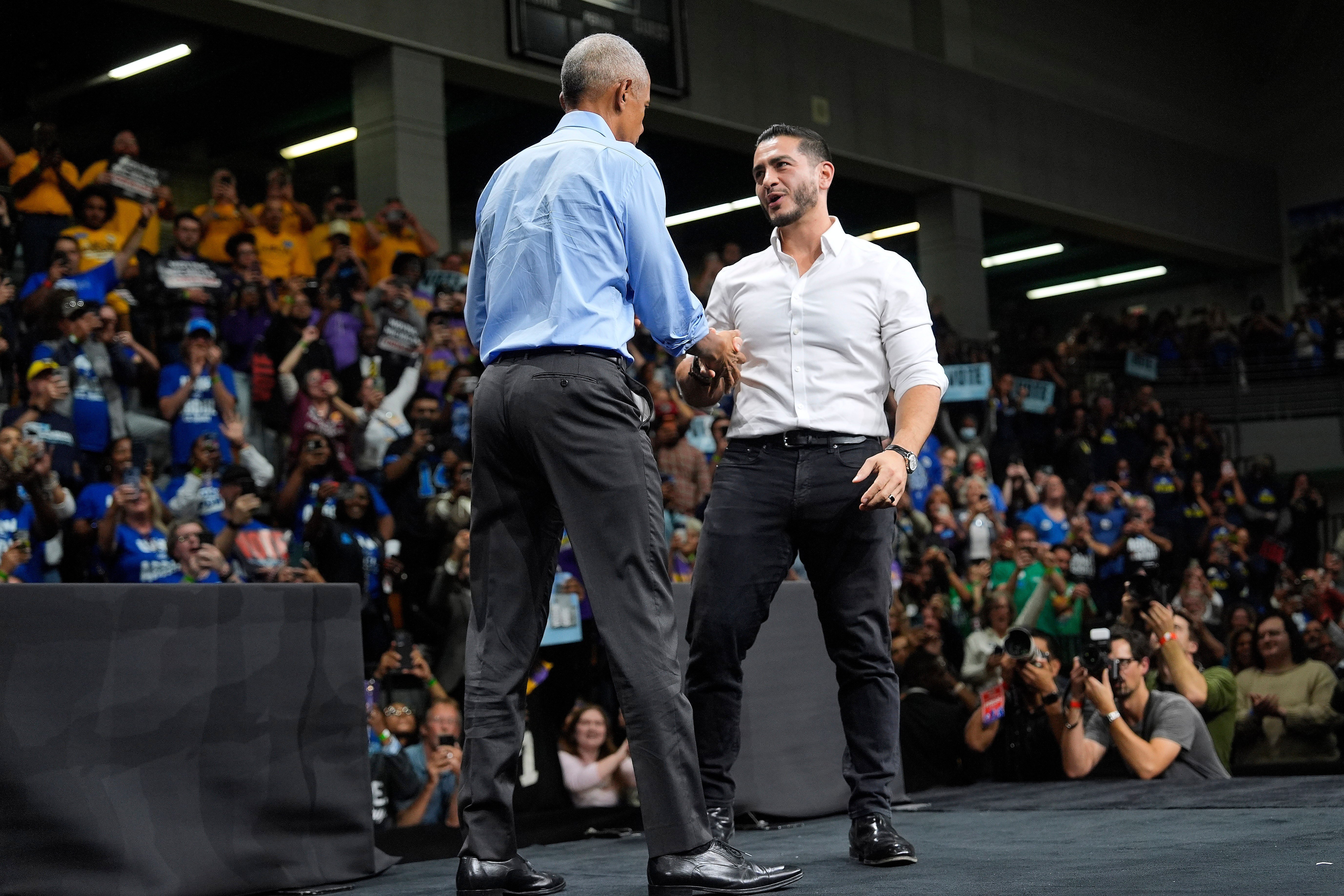
With the midterms just days away, former President Barack Obama hit the campaign trail in Ohio and Michigan, but his appearance on behalf of Democratic Senate hopeful Abdul El-Sayed has reignited a fierce debate over how to handle the candidate's controversial associations. In a series of stops over the weekend, Obama sought to frame questions about El-Sayed's past support for the Muslim Brotherhood as a smear tactic reminiscent of the birther movement that dogged his own presidency.
At a rally in Detroit, Obama told the crowd, "They will use lies, and maybe your name or your faith to somehow suggest you are dangerous and less American than they are. We have seen this movie before. I starred in it! I've got a long-form birth certificate to prove it. This stuff didn't work on me in Michigan, it's not going to work on Abdul." The former president's remarks were part of a broader effort to shore up El-Sayed's flagging support among Black voters, a traditionally reliable Democratic constituency. Recent polling shows Republican nominee Mike Rogers, endorsed by Donald Trump, pulling an unprecedented 33 percent of the Black vote in the state, a troubling sign for Democrats.
But critics argue Obama's comparison is fundamentally flawed. The birther conspiracy theory was baseless, while El-Sayed's connections to the Muslim Brotherhood are documented. His mother reportedly worked for the organization, and his sister publicly boasted about that fact online years before his candidacy. More damning, El-Sayed signed a 2012 letter supporting then-Egyptian President Mohamed Morsi, a Muslim Brotherhood figure, and urging him to purge opposition from the media and police—at a time when human rights groups were pleading with Morsi to stop arresting journalists.
During his campaign, El-Sayed has refused to answer questions about these ties, instead berating reporters who raise the issue. Obama's attempt to equate legitimate scrutiny with racism has drawn sharp rebukes from those who see it as a cynical deflection. "It is not Islamophobic to ask a candidate why he signed a letter supporting a group that multiple countries designate as a terrorist organization," said one political analyst. "To suggest otherwise is to imply that all Muslims share El-Sayed's views, which is itself a racist assumption."
Obama went further, dismissing any characterization of El-Sayed as radical. "What they're doing, which is par for the course, is running all kinds of scary ads to make you think Democrats are radicals or communists or jihadists or the woke police," he said. "We are not going to fall for that. Abdul is fighting for change, real change. He's taking on politics and corrupt politics that only benefits people with enough money and power to game a broken system in Washington at your expense." But critics point to El-Sayed's campaign rhetoric, including his characterization of Israel as an enemy on par with Iran and his campaign appearances with Hasan Piker, a left-wing streamer who has said America deserved 9/11.
El-Sayed has also been criticized for suggesting that a terror attack on a Jewish preschool, which nearly killed 140 children, could be explained by "hurt people hurt people." His primary opponent, Rep. Haley Stevens, accused him of questioning her loyalty to Israel, a charge that many see as anti-Semitic. Obama's framing, which lumps these issues with mainstream policy proposals like Medicare for All, has been called "the purest form of woke gaslighting" by some commentators.
The controversy comes as Trump has targeted El-Sayed over security screening, and some warn that attacks on El-Sayed's faith could backfire with Muslim voters. Obama's own cheesecake factory jab at Trump has also stirred controversy, but the focus remains on El-Sayed's record. As the race tightens, with gas prices threatening GOP turnout, Obama's defense of El-Sayed may do little to sway undecided voters who are troubled by the candidate's refusal to condemn terrorism.