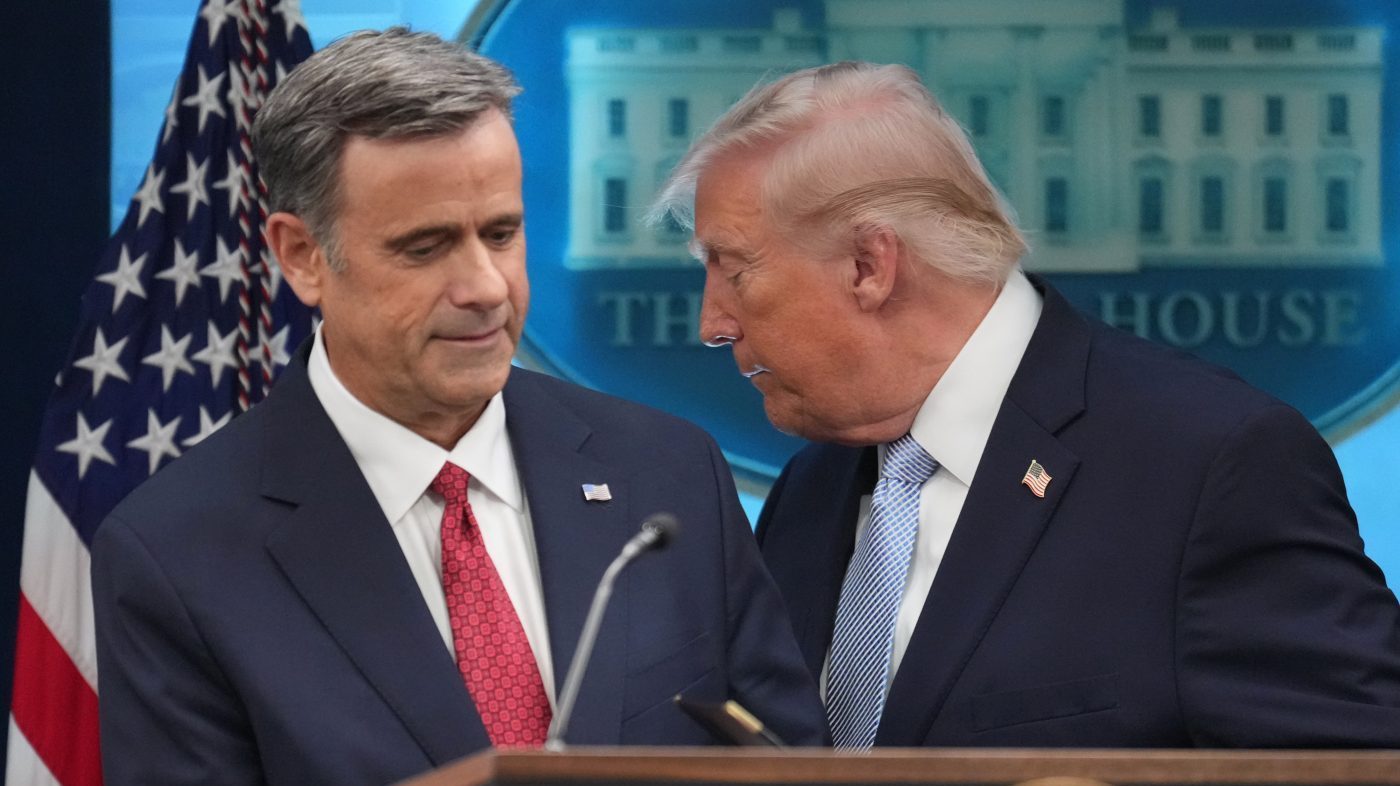
President Trump on Wednesday sought to lower expectations around CIA Director John Ratcliffe's visit to Moscow, describing the trip as “semi-routine” even as the Kremlin confirmed that Ratcliffe had met with senior Russian intelligence officials. The remarks came during an interview with conservative host Glenn Beck, where Trump pushed back against speculation that the visit was tied to NATO tensions or a broader strategic realignment.
“I hate to disappoint people,” Trump said. “John Ratcliffe is a fantastic guy. He's the head of the CIA, and he is not in there for any of the things you said.” Beck had raised the possibility that the trip could test alliance resolve, a notion Trump dismissed.
Still, Trump hinted that the visit could yield tangible results, particularly regarding the ongoing war in Ukraine. “Now something may come out, you know, out of it,” he said, adding, “Frankly, they both want to see it ended at this point.” That comment appeared to refer to both Russia and Ukraine, suggesting a possible opening for renewed peace talks.
Kremlin spokesperson Dmitry Peskov confirmed Wednesday that Ratcliffe held discussions with his Russian intelligence counterparts during the visit, but stressed that no meeting with President Vladimir Putin had taken place. “Of course, President Putin is immediately informed of everything,” Peskov said, according to The Associated Press.
The trip marks Ratcliffe's first known visit to Russia since his confirmation as CIA director in 2025. The timing has drawn attention, especially after the administration's shift in economic policy and its broader foreign policy posture. The Financial Times reported that the Trump administration had asked Ukrainian officials to refrain from striking Moscow, St. Petersburg, and northern Russian regions with long-range drones and missiles on Monday, Tuesday, and Wednesday because a senior U.S. official was traveling to Moscow.
That request, if confirmed, underscores the delicate balancing act Washington is playing as it seeks to maintain support for Ukraine while opening direct channels with Moscow. Trump's characterization of the visit as routine stands in contrast to the secrecy surrounding it, and analysts are watching for any signs of a breakthrough or a potential shift in U.S. strategy.
The visit also comes amid broader questions about the administration's approach to Russia, including its handling of Russian influence operations and its willingness to engage with Putin's government. Trump's comments suggest he is eager to project an image of pragmatic diplomacy, even as critics warn against granting legitimacy to Moscow's actions.
For now, the White House is offering few details about what was discussed in Moscow. Trump's vague references to a possible outcome leave room for interpretation, but his emphasis on ending the war in Ukraine aligns with his campaign promises. Whether Ratcliffe's conversations will lead to concrete steps remains unclear, but the president's tone suggests he sees the visit as a potential opening.
The trip has also reignited debate over the administration's handling of intelligence sharing and its relationship with allies. Some lawmakers have expressed concern that direct talks with Russian intelligence could undermine trust with NATO partners, a sentiment that echoes recent frictions with Canada over trade and security. However, Trump dismissed such worries, framing the visit as a routine part of intelligence work.
As the situation develops, the world will be watching to see whether Ratcliffe's trip yields any substantive progress on Ukraine or merely serves as a symbolic gesture. Trump's downplaying of the visit suggests he wants to manage expectations, but his own comments hint that more may be in the works.