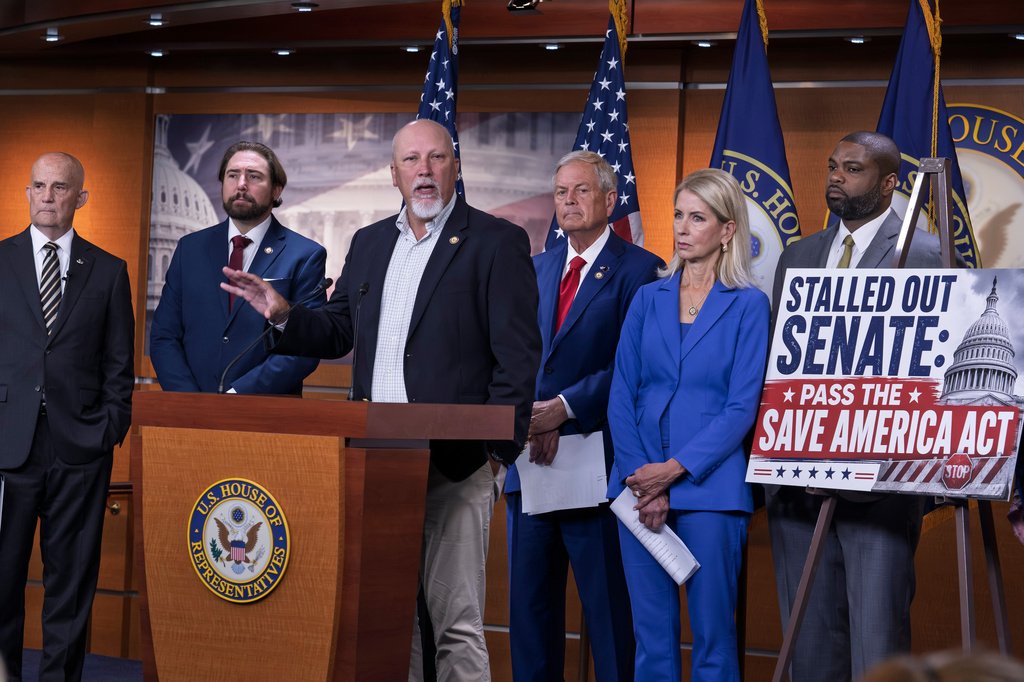
President Trump recently took to Truth Social to argue that without the Safeguard American Voter Eligibility (SAVE) Act, the Republican Party faces electoral extinction. He wrote, "The Republican Party will never win another Election. I will, sadly, be the last Republican president." This from a man who claims a landslide victory in 2024 with 49.8 percent of the vote, while his party holds both chambers of Congress.
Trump's core claim—that Democrats will cheat in the 2026 midterms—rests on a foundation of unproven allegations. Despite his repeated promises, he has never produced evidence of widespread fraud that would have changed the 2020 outcome. Notably, House Republicans actually gained seats that year, an odd result if the election was rigged against them.
Even Trump's own attorney general, Bill Barr, told him the Justice Department found no evidence of fraud sufficient to overturn the election. Polls, including Trump's internal ones, predicted a Joe Biden win. Yet 54 percent of Republicans now believe voter fraud is widespread, a belief that persists despite the facts.
Trump's warning that Republicans are doomed without the SAVE Act ignores the current landscape. Republicans control the governorship and legislature in 23 states, while Democrats have full control in only 16. Eleven states have divided government. Even if fraud were a concern, it would be nearly impossible to execute in red states or divided ones. The real threat to GOP majorities is not phantom fraud but the historical trend of midterm losses for the president's party, especially when promises on inflation and the economy go unfulfilled.
The SAVE Act includes popular provisions: 80 percent of Americans support photo ID requirements, and 66 percent back proof of citizenship to register. However, Trump's demand to end mail-in voting is more contentious. Currently, eight states and D.C. conduct all elections by mail; only one is a red state (Utah), where the system works well. The bill also requires states to submit voter rolls to the federal government, but many states resist due to constitutional authority over elections.
States are already improving security. The National Conference of State Legislators notes that all 50 states now conduct post-election audits. The Voting Rights Lab has identified four best practices that could boost confidence without federal mandates. The real problem for the SAVE Act is the Senate, where it lacks the 60 votes to overcome a filibuster. Even if Republicans eliminated the filibuster, Democrats could repeal the law when they next control Congress, a scenario that undermines the bill's long-term impact.
The SAVE Act is a political tool, not a solution. Trump's focus on manufactured crises distracts from the real work of governance—delivering on economic promises. As the administration faces pressure on gas prices and other issues, the best way to secure future wins is to address voter concerns, not to chase a phantom fraud threat. The GOP's path forward lies in policy performance, not in restrictive voting laws that may never pass.