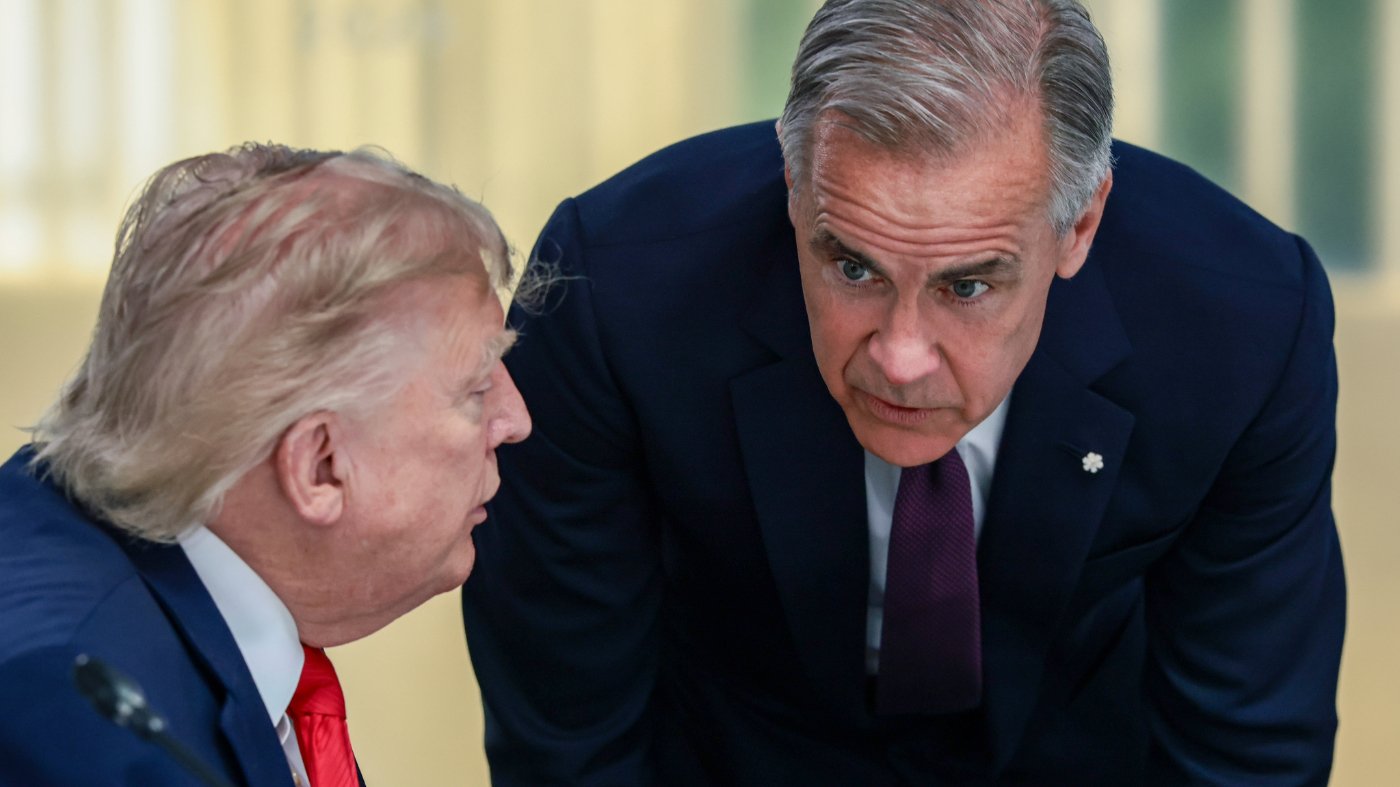
On May 28, Prime Minister Mark Carney stood before the Economic Club of New York and declared, “Canada Strong will help make America great again.” It was a rhetorical twist designed to flatter President Trump, but the applause masked a deeper problem: the day before, his government had chosen a Swedish defense contractor over an American one for a critical NORAD system.
Carney's line — quickly branded “Maple MAGA” by observers — was meant as a gesture of partnership. But in Washington, career officials don't parse speeches for policy. They read procurement decisions. And Ottawa's choice of Saab for Canada's new Airborne Early Warning and Control aircraft sent a different message entirely.
The AEW&C system is not a peripheral purchase. Its effectiveness depends on seamless integration with NORAD's network, which is overwhelmingly American. By picking Saab over the U.S. alternative that many analysts considered the safer bet, Carney's government introduced an integration risk that now must be proven rather than assumed. The timing — one day before a speech flattering Washington on strategic partnership — was hardly subtle.
This was not an isolated misstep. Just ten days earlier, on May 18, Pentagon policy chief Elbridge Colby announced the U.S. was “pausing” the Permanent Joint Board on Defense, the oldest continuous U.S.-Canada defense consultation mechanism, dating back to 1940. Colby said the pause was to “reassess how this forum benefits shared North American defense.” That move alone signaled fraying trust.
The contrast between Carney's words and his government's actions has not gone unnoticed in defense circles. As House lawmakers advance a $1.1 trillion defense bill that includes a Pentagon name change, the signals from Ottawa appear disjointed. Carney's team seems to be running two strategies: one that courts Washington with MAGA-friendly language, and another that prioritizes European defense suppliers over American ones.
For a prime minister who built his reputation on technocratic competence, the inconsistency is jarring. Defense procurement is not a minor portfolio — it is a direct reflection of strategic priorities. By choosing Saab, Carney effectively told NORAD partners that interoperability with U.S. systems is negotiable. That is not the kind of message that builds trust, especially when Beijing is blacklisting U.S. defense firms and restricting dual-use exports.
Some analysts argue the Saab decision was based on cost or capability. But in the context of a “paused” joint defense board and a prime minister praising MAGA, it looks like policy whiplash. The U.S. defense establishment expects consistency from allies. Canada, which depends on NORAD for its air sovereignty, cannot afford to send mixed signals.
Carney's “Maple MAGA” moment may have earned him headlines, but it is his procurement decisions that will define his defense legacy. And so far, those decisions are telling a different story — one of strategic confusion, not partnership.