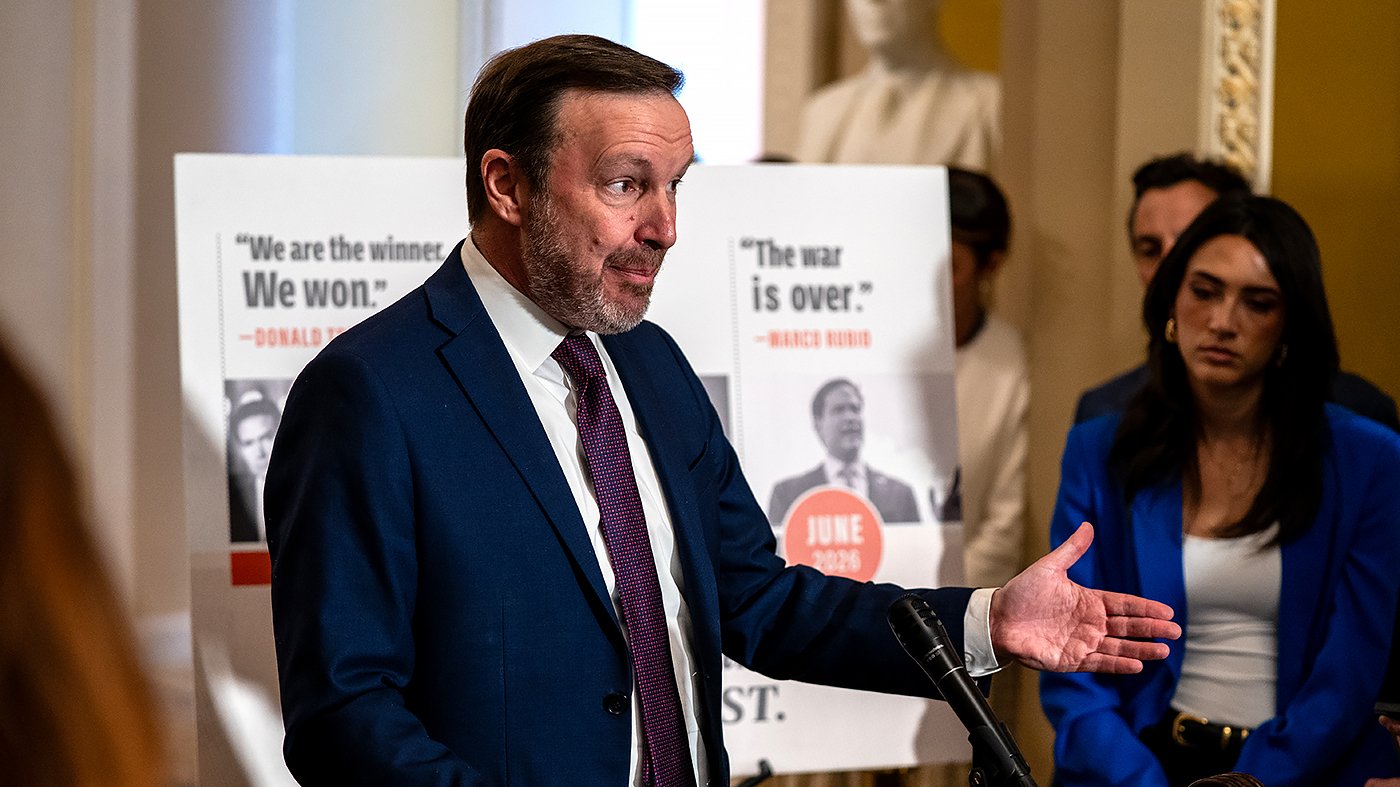
Sen. Chris Murphy (D-Conn.) declared on Sunday that President Trump represents the “biggest threat” to the United States, pushing back against growing alarm within his party over the rise of democratic socialist candidates in recent primaries.
Appearing on NBC News’s “Meet the Press,” Murphy told host Ryan Nobles that what unites all Democratic contenders, including those who won House primaries in New York last week, is their commitment to safeguarding American democracy. “And right now the biggest threat to this country is — are not a handful of House candidates in New York. It is the president of the United States that is trying to destroy American democracy,” Murphy said. He added that the Democratic Party, across its ideological spectrum, is united in the need to protect the nation from Trump’s assaults on the rule of law.
The senator’s comments come as democratic socialists have gained national attention, rattling establishment Democrats with primary victories ahead of the November midterms. Senator Bernie Sanders (I-Vt.) first brought democratic socialism into the mainstream a decade ago during his presidential run, paving the way for figures like Rep. Alexandria Ocasio-Cortez (D-N.Y.).
Last year, New York City Mayor Zohran Mamdani (D) amplified the movement’s profile by winning the top job in the country’s largest city. In Washington, D.C., democratic socialist Janeese Lewis George is poised to become the next mayor, while Nithya Raman, another movement ally, advanced to the mayoral runoff in Los Angeles scheduled for this fall.
Murphy’s remarks downplay concerns that far-left candidates could hurt the party’s chances in the general election. He argued that the focus should remain on Trump’s actions, which he says threaten democratic institutions. The White House has not yet responded to a request for comment on Murphy’s statements.
The debate over the party’s direction comes amid broader political turbulence. Trump has recently clashed with independent agencies, and the Supreme Court has weighed in on his power to fire officials, including Federal Reserve Governor Lisa Cook. In a related development, the Court temporarily blocked Trump’s attempt to oust Cook, a move that highlights ongoing tensions over executive authority. Meanwhile, some GOP senators have warned that Trump’s economic policies could backfire in the midterms, as inflation remains a pressing issue for voters.
Murphy’s insistence on party unity reflects a strategic calculation: that Democrats must present a united front against Trump rather than splinter over internal ideological battles. Whether that approach will resonate with voters in November remains to be seen, as both the left flank and the center grapple with how to counter the president’s influence.