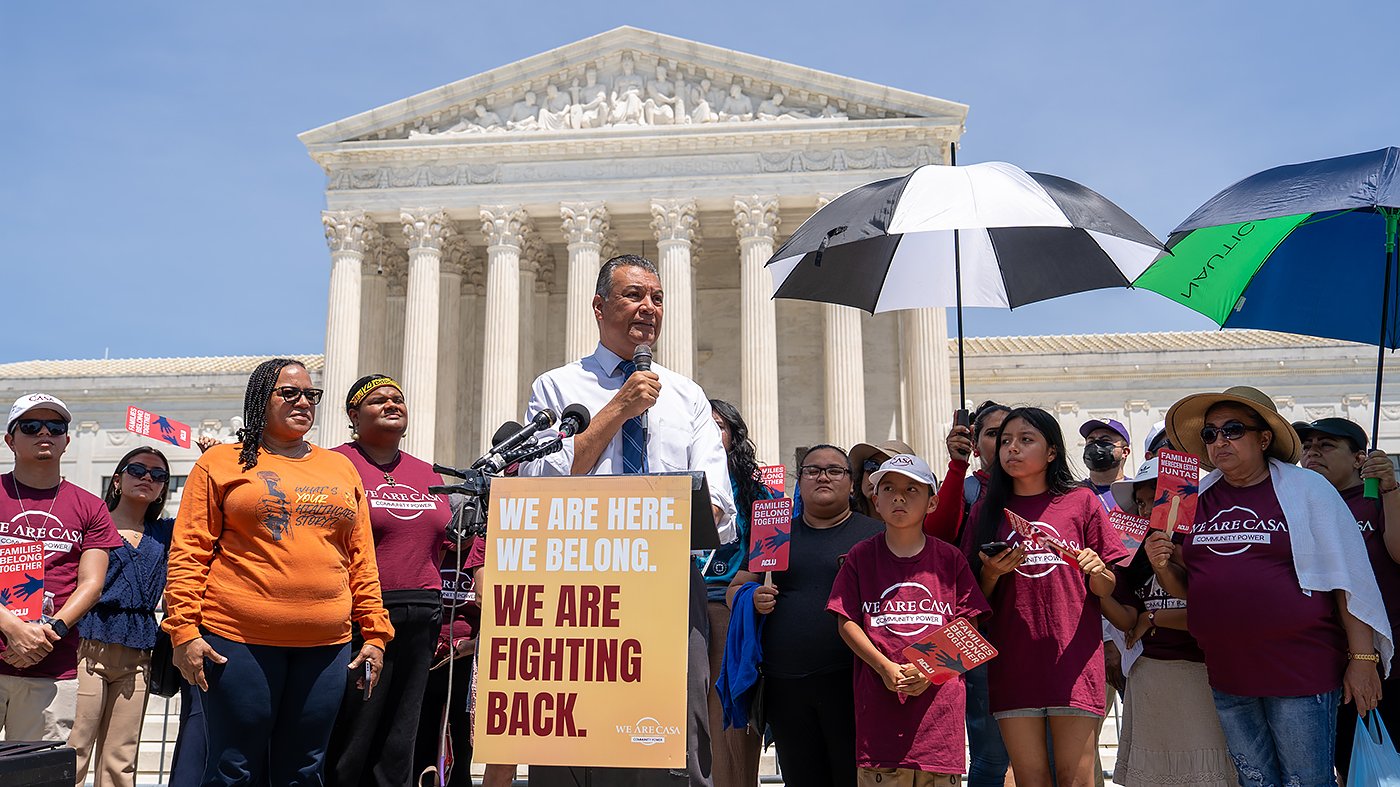
The Supreme Court on Tuesday delivered a significant setback to President Trump's immigration agenda, ruling that nearly all individuals born on American soil are entitled to U.S. citizenship. The decision, which reaffirms the long-standing principle of birthright citizenship, marks a stinging defeat for a president who has made curbing illegal immigration and reshaping the national debate on the issue a cornerstone of his tenure.
The ruling struck at the heart of Trump's broader immigration strategy, which has ranged from the iconic "build the wall" rallies of his first campaign to the highly contentious ICE raids that have defined his second term. While Trump has succeeded in dramatically reducing unauthorized crossings at the southern border, his interior enforcement actions have sparked widespread controversy. According to RealClearPolitics polling averages, a majority of the public now disapproves of Trump's immigration policies, with 51 percent opposed versus 45 percent in favor—a notable shift from the 2024 campaign, when immigration was his strongest issue against then-Vice President Harris.

Court's Rationale and Historical Precedent
Chief Justice John Roberts, writing for the majority, anchored the decision in the 1898 case of Wong Kim Ark, which established that a person born in the United States to Chinese parents was a citizen. "We see no reason to depart from that view today," Roberts wrote. He concluded that the framers of the Fourteenth Amendment intended to extend citizenship to "every free-born person in this land," adding, "We keep that promise today." The majority included conservative Roberts and Trump-appointed Justice Amy Coney Barrett, joining the court's three liberal justices—Ketanji Brown Jackson, Elena Kagan, and Sonia Sotomayor.
Immigrant advocacy groups estimate that roughly 250,000 babies born annually in the U.S. would have been affected had the Court ruled differently. The decision effectively blocks Trump's efforts to reinterpret the Fourteenth Amendment's Citizenship Clause, which he had long argued was never meant to cover children of undocumented immigrants or those on temporary visas.
Trump and Allies React
Trump's response was measured but pointed. On social media, he sarcastically congratulated China and President Xi Jinping "on their massive Birthright Citizenship WIN!" and called the decision "too bad" for the country. Other Republicans were far more critical. Senator Eric Schmitt (R-Mo.) blasted the ruling as "wrong, dangerous, and disastrous for American sovereignty" and called for a constitutional amendment. Senator Mike Lee (R-Utah) echoed that call, while Senator Ted Cruz (R-Texas) labeled the decision a "travesty" and urged Congress to act. The Heritage Foundation's president, Kevin Roberts, described it as "a tremendous betrayal of the republic" that has "inflamed the all-out assault on our sovereignty."
Despite the outcry, Trump expressed little enthusiasm for the arduous constitutional amendment process, which would require two-thirds majorities in both chambers of Congress and ratification by 38 states. Instead, he suggested on TruthSocial that "we can easily make it up in Congress through Legislation." However, the legislative path remains murky following the Supreme Court's clear affirmation of birthright citizenship.
Broader Implications and Other Court Wins
The ruling underscores a broader symbolic defeat for Trump, who has consistently portrayed migrants as exploiting the system. His allies often use terms like "anchor babies" and "birth tourism" to criticize birthright citizenship. Yet the Court, including two conservative justices, rejected that narrative. Florida Governor Ron DeSantis (R) acknowledged the ruling as a "major defeat" for conservatives.
Trump did notch other victories before the Supreme Court this term. On Monday, the Court expanded presidential power to fire officials from independent agencies, and last week it backed his administration's efforts to turn back asylum-seekers. He has also set the lowest refugee cap in history. But the birthright citizenship defeat carries particular sting given his sustained attacks on the concept. For a deeper look at the legal clashes within the GOP, see our coverage of how GOP legal minds are grappling with the ruling. Meanwhile, some Republicans are already pushing for legislative responses, as Representative Lawler argues Congress must act on birth tourism. The Heritage Foundation's president has also weighed in, calling the decision a 'betrayal' of the republic.
As the political fallout continues, the ruling solidifies birthright citizenship as a constitutional bedrock—at least for now. Whether Trump and his allies can rally enough support for a legislative or constitutional challenge remains an open question, but the Court's message is clear: the promise of the Fourteenth Amendment endures.