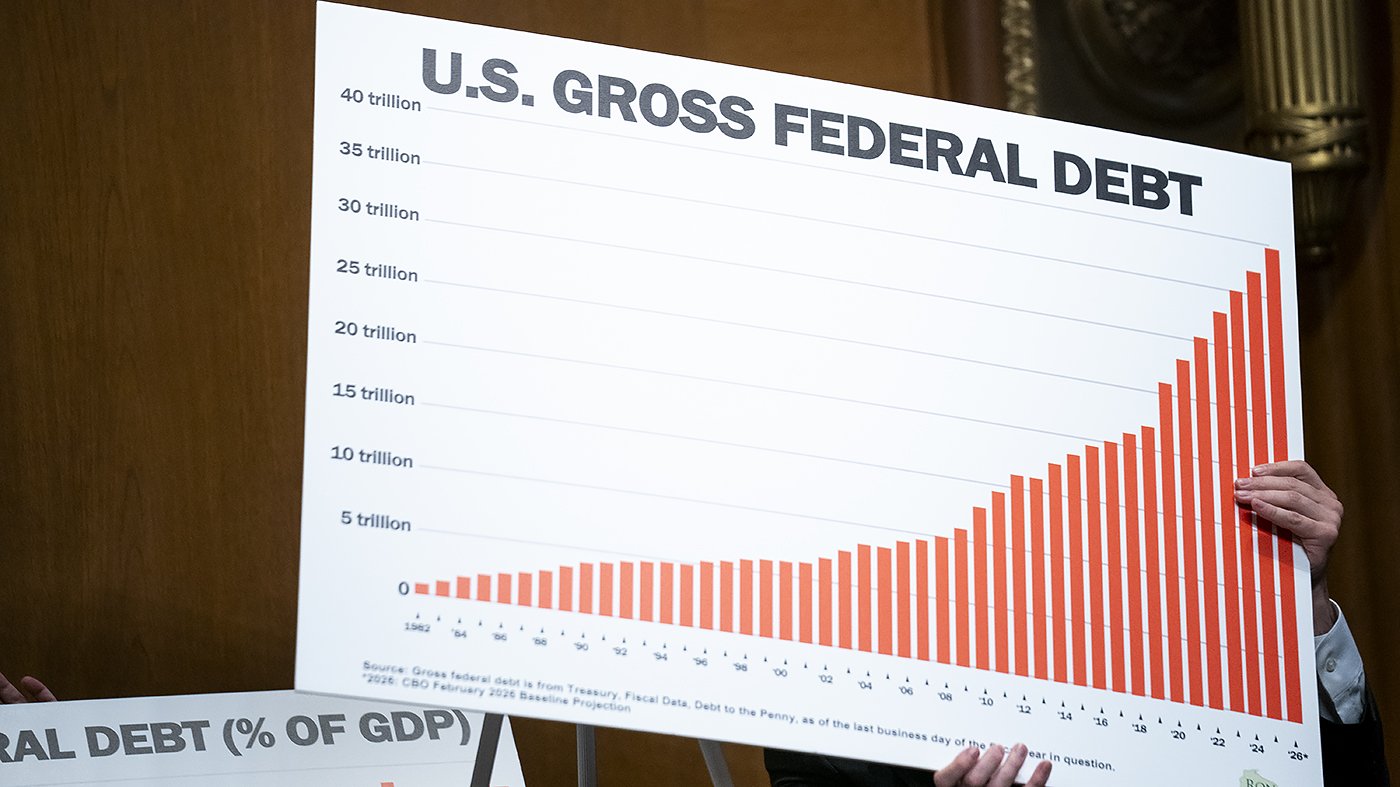
The United States has crossed a troubling fiscal milestone: the national debt now exceeds the entire size of the American economy. Data released Thursday by the Bureau of Economic Analysis shows that debt held by the public reached 100.2 percent of gross domestic product at the end of March, with total public debt hitting $31.27 trillion against a $31.22 trillion economy. The last time debt-to-GDP was this high was in the aftermath of World War II, and analysts warn it could soon surpass that 106 percent record.
Marc Goldwein, senior vice president of the Committee for a Responsible Federal Budget, did not mince words. “This didn’t happen because of a seismic global conflict, but rather a total bipartisan abdication of making hard choices,” he said. Goldwein noted that the debt is now roughly twice the historic average, calling the situation “a scary place to be.”

The Treasury Department reported last month that total national debt had surpassed $39 trillion, a milestone reached just five months after crossing $38 trillion. The government currently spends $1.33 for every dollar it collects in revenue, with the budget deficit projected at $1.9 trillion this year, according to The Wall Street Journal.
Goldwein warned that rising debt erodes prosperity for current and future generations. “Rising debt compromises affordability by slowing income growth, pushing up interest rates, and increasing inflationary pressures,” he said. “Debt squeezes our budgets with massive interest costs.” He also cautioned that the fiscal path exposes the U.S. to challenges from geopolitical rivals and could trigger a devastating fiscal crisis if left unchecked.
The Congressional Budget Office issued a stark warning in February: if current policies remain unchanged, debt held by the public will climb to 108 percent of GDP by 2030 and 120 percent by 2036, with the deficit ballooning to $3.1 trillion. CBO Director Phillip Swagel stated, “Our budget projections continue to indicate that the fiscal trajectory is not sustainable.” The CBO attributed the worsening outlook to the One Big Beautiful Bill Act signed into law last July, along with higher tariffs and lower immigration rates.
This fiscal deterioration comes amid broader economic pressures. March inflation hit 3.5% as the Iran conflict drove up prices, stoking political pressure on the administration. Meanwhile, domestic turmoil has exposed flaws in Trump’s foreign policy outreach, adding to the sense of crisis in Washington.
Goldwein’s core question remains unanswered: “The real question is whether or not our leaders in Washington will listen.” With the debt now larger than the economy, the alarm bells are ringing louder than ever.